
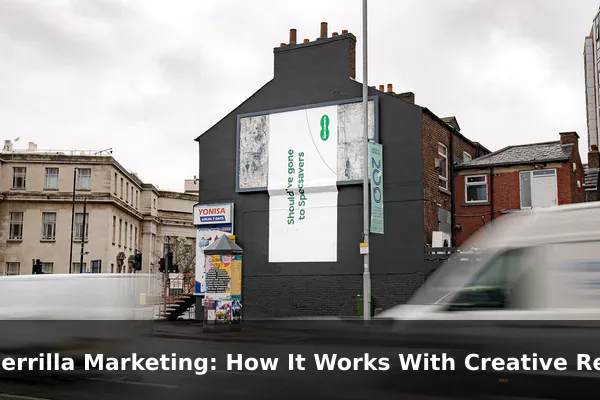
When a brand paints a giant shoe on a city crosswalk or transforms a bus stop into an immersive coffee experience, people stop, stare, and reach for their phones. That is guerrilla marketing — unexpected, creative, and built to generate maximum attention with minimum spend. Unlike traditional advertising that interrupts audiences on screens, guerrilla campaigns meet people in the real world and leave impressions that stick long after the moment has passed.
The concept was introduced by marketing author Jay Conrad Levinson in his 1984 book of the same name, and it has only grown more relevant as digital noise makes conventional ads easier to scroll past. Today, guerrilla marketing is used by global companies and neighborhood businesses alike to create buzz, earn media coverage, and build genuine word-of-mouth reach. This article breaks down what it is, why it works, the formats it takes, real-world examples, the risks involved, and a practical planning framework you can follow.
What Guerrilla Marketing Means in Practice
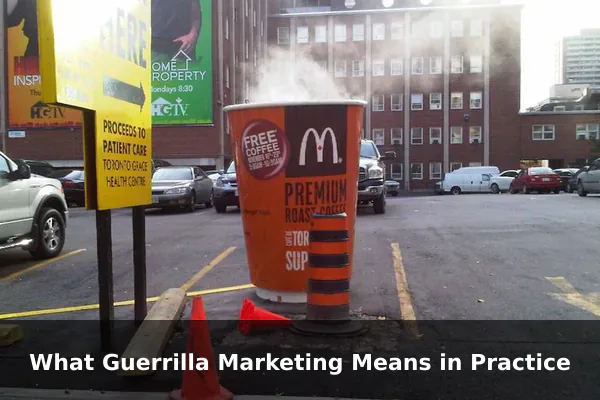
Guerrilla marketing is a low-cost, unconventional promotional strategy that uses surprise, creativity, and public environments to generate attention. Instead of purchasing ad space, the brand inserts itself into a real-world moment in a way that feels unexpected and worth talking about.
The term is borrowed from guerrilla warfare, where small forces use agility and surprise to compete against larger opponents. In marketing, the same logic applies: a genuinely creative idea can outperform a much bigger budget.
- Unconventional: breaks from standard advertising formats and placements
- Public-facing: occurs in shared physical or digital environments
- Low-cost relative to impact: invests in ideas rather than media buys
- Surprise-driven: the unexpected element is central to the effect
It differs from experiential marketing in an important way. Guerrilla campaigns often reach passersby who never opted in, while experiential events are structured setups where audiences choose to participate. Both can overlap, but the unplanned encounter is what defines guerrilla at its core.
Why Guerrilla Marketing Works
Guerrilla campaigns succeed because they align with how human attention and memory actually function. Understanding these mechanisms helps marketers design campaigns that genuinely land.
The Surprise Effect
The brain flags things that are out of place. When something unexpected appears in a familiar environment — a statue positioned mid-crosswalk to highlight road safety, or a building wrap making it appear a product is bursting through the wall — the brain registers it as significant and encodes it more deeply than routine stimuli.
Shareability and Earned Media
Before social media, guerrilla campaigns relied on word-of-mouth and press coverage. Today, a striking outdoor stunt becomes a shareable photo within seconds of being seen. The campaign lives online long after the physical installation is removed, extending reach far beyond the original location without additional spend.
Emotional Resonance
The most effective guerrilla campaigns make people feel something — surprise, delight, curiosity, or even mild shock. Emotional reactions are among the strongest predictors of whether someone will remember and share a brand experience, which is why purely informational stunts rarely go viral.
Common Types of Guerrilla Marketing
Guerrilla marketing takes many forms depending on budget, audience, and brand personality. These are the most widely used formats.
Ambient Marketing
Ambient marketing places brand messages within the environment in contextually clever ways. A coffee brand turning a manhole steam vent cover into a giant cup graphic, or an insurance company using sidewalk cracks to remind people about home protection, are classic ambient examples.
Street Installations and Props
Physical pop-ups, 3D street art, oversized product replicas, or branded objects placed in unexpected public locations. These are designed primarily to stop foot traffic and prompt photography.
Experiential Stunts
Live activations where real people interact directly with the brand — a sportswear company converting a subway car into a pop-up gym, or a food brand handing samples inside a branded environment that photographs beautifully.
Flash Mobs and Live Performances
Organized performances — dance routines, musical acts, or theatrical pieces — that appear spontaneous but are carefully planned brand activations. They attract crowds, generate video content, and create a sense of shared community experience.
Digital and Viral Guerrilla Tactics
Online equivalents include coordinated hashtag campaigns, staged viral moments, and social media stunts where brand content is designed to look organic while spreading rapidly. The principles of surprise and shareability apply just as strongly online.
Creative Real Examples of Guerrilla Marketing
IKEA’s Metro Station Makeover
IKEA furnished a real Stockholm metro station to look like a fully decorated home — bookshelves, lamps, rugs, and soft furnishings filling the platform. Commuters stepped into what felt like a living room mid-commute. The installation was photographed and shared worldwide, generating media coverage worth far more than the build cost.
Frontline’s Shopping Mall Floor Ad
Frontline placed a giant image of a dog scratching itself on the floor of a multi-story shopping mall. Viewed from upper floors, shoppers walking across the image appeared as the fleas. The perspective trick worked perfectly in that setting and spread rapidly online as a clever, zero-production-cost viral moment.
The Blair Witch Project’s Fake Reality Campaign
Before large-scale social media existed, the film’s marketing team created fake police reports, missing person flyers, and a documentary-style website claiming the story was real. The campaign built massive word-of-mouth and contributed to one of the highest return-on-investment films ever made at the time — a landmark case in guerrilla thinking applied to entertainment.
Deadpool’s Unconventional Movie Launch
The Deadpool marketing team built the campaign around the character’s irreverent personality. A Tinder profile for Deadpool, a Valentine’s Day framing for an R-rated superhero film, and staged photos spread across social media. Each piece felt authentic to the brand voice and drove enormous pre-release conversation at minimal cost.
Red Bull’s Space Jump Stunt
Red Bull’s sponsorship of Felix Baumgartner’s stratospheric free fall was a guerrilla-style brand activation at global scale. Not a traditional ad — a live event watched by millions that generated billions of impressions and perfectly aligned with the brand’s gives you wings positioning.
Benefits for Small Brands and Big Companies
Guerrilla marketing is one of the few strategies that scales effectively in both directions.
- For small businesses: competes for attention without large media budgets, a single strong idea can generate local press and community buzz, and it builds brand personality against larger competitors.
- For large companies: refreshes brand perception outside paid placements, creates social content with organic reach, and cuts through ad fatigue in saturated markets.
Both sizes benefit from the earned media multiplier. When a campaign is genuinely surprising or creative, journalists, bloggers, and social accounts cover it for free — delivering reach that paid placement cannot always replicate.
Risks, Mistakes, and Ethical Concerns
Not every guerrilla campaign lands as intended. Understanding the risks before planning is essential.
Legal and Permit Issues
Placing anything on public or private property without permission can lead to fines, immediate removal, or worse. Always clarify what permits are required for outdoor installations, projections, or handouts in specific locations. What is allowed varies significantly by city and country.
Public Backlash and Tone Misjudgment
A campaign that reads as offensive, appropriative, or tone-deaf can go viral for all the wrong reasons. Brands have faced serious backlash for stunts that triggered public fear, mocked communities, or caused significant inconvenience to bystanders who had no interest in engaging.
Safety and Liability
Physical stunts that block traffic, create crowds in narrow spaces, or involve elevated structures carry real safety liability. Any activation in a public space requires proper safety planning and sometimes insurance.
Brand Misalignment
A bold stunt that does not fit the brand’s established voice can confuse more than it converts. Guerrilla marketing should feel like a natural extension of what the brand already stands for — not a departure that leaves audiences wondering if they have the right company.
How to Plan a Guerrilla Marketing Campaign
A successful campaign requires more planning than it might appear from the outside. This eight-step framework covers the essentials.
- Define your objective — Is the goal awareness, a product launch, event promotion, or repositioning? The answer shapes every creative decision.
- Know your audience — Where do they spend time? What do they find funny, moving, or share-worthy?
- Develop the core idea — It must be surprising, brand-relevant, and understandable within seconds of being encountered.
- Choose the right location or channel — Foot traffic, demographics, and visual context all affect whether the stunt will land.
- Check permissions — Confirm what is allowed and budget for permits where needed.
- Plan amplification — Photograph and video the activation for social media. Consider alerting local press in advance.
- Define success metrics — Social shares, press mentions, foot traffic changes, or hashtag volume depending on the goal.
- Set a realistic budget — Guerrilla is low-cost, not no-cost. Production, permits, and staffing must be accounted for before launch.
When Guerrilla Marketing Is the Right Choice
Guerrilla marketing fits best when the brand has a bold or unconventional personality, the budget is limited but creative resources are available, the target audience shares content readily, or when a product launch needs concentrated attention quickly. It also works well in crowded markets where standard advertising is producing diminishing returns.
It is less suited for highly regulated industries where messaging must be precisely controlled, or for brands whose audiences expect formal, conservative communication. The approach demands a certain brand confidence — knowing that an unexpected move will feel exciting rather than off-putting to the people you are trying to reach.
Guerrilla marketing remains one of the most exciting and cost-effective tools available to marketers at every budget level. It rewards creativity over spend, turns shared spaces into brand moments, and generates the kind of organic conversation that paid placements often cannot buy. Whether you run a local business looking to stand out in your neighborhood or a growing brand ready to make a bigger statement, the core principle is the same: know your audience, find a surprising context, and give people something genuinely worth sharing. The brands that do it well do not just grab attention — they earn it.
