

Every purchase tells a story. Whether someone chooses a premium coffee over a generic brand or spends hours comparing laptops before clicking buy, each decision reflects a layered mix of needs, emotions, past experiences, and outside influence. Understanding why people make the choices they do is one of the most valuable things a marketer can learn.
Consumer behavior is the study of how individuals and groups select, buy, use, and respond to goods, services, and experiences. It draws on psychology, sociology, economics, and cultural context to explain what truly drives purchasing decisions — and why rational logic alone rarely tells the full story. For marketers and business owners, this is not an academic exercise. It is a practical framework that shapes everything from product design and pricing to ad copy and retention strategy. This guide breaks down the key factors at play and uses real-world examples to show how the theory translates into better decisions.
What Consumer Behavior Means in Marketing
In a marketing context, consumer behavior refers to the process and patterns behind how consumers identify a need, search for solutions, compare options, commit to a purchase, and react afterward. Marketers study this process to design more relevant campaigns, products, and customer experiences.
At its core, consumer behavior answers three questions: What do consumers buy? Why do they buy it? And how do they decide? The answers are rarely straightforward. A consumer might buy a luxury watch not for its timekeeping function but for the social status it signals. A first-time parent might choose an organic baby brand because of perceived safety, not price or convenience. These layered motivations are what make consumer behavior both complex and commercially important.
- It informs campaign strategy by revealing which emotional or rational triggers move buyers to act.
- It guides product development by identifying which features actually matter to the end user.
- It improves customer experience by exposing friction points in the buying journey before they cause churn.
Why Consumer Behavior Matters for Business Growth
Businesses that ignore consumer behavior tend to struggle with misaligned messaging, weak product-market fit, and high acquisition costs. Those that invest in understanding their buyers build a compounding advantage over time.
Behavior insights improve nearly every layer of the marketing function. Better segmentation becomes possible when you divide audiences by values and habits rather than demographics alone. Messaging becomes sharper when it speaks directly to a proven motivation. Product decisions improve when behavior data reveals what users ignore versus what they rely on daily. Retention improves when post-purchase pain points are identified early and addressed before they become a reason to leave.
In short, the more accurately a business understands how and why its customers behave, the less it has to guess — and guessing is expensive.
Psychological Factors That Influence Buying Decisions
Psychology plays a central role in consumer behavior. Even when buyers believe their choices are purely rational, psychological forces are shaping their decisions in the background.
Motivation
Maslow’s hierarchy of needs offers a useful starting point. A consumer buying a meal is satisfying a physiological need. A consumer paying for a premium gym membership is addressing esteem and self-actualization. Identifying which level of motivation drives your customer helps frame the right value proposition in your messaging.
Perception
Two people can encounter the same product and form completely different impressions. Perception is shaped by selective attention, brand reputation, packaging, reviews, and context. A product displayed in a high-end retailer feels more premium than the identical product on a discount shelf. Marketers manage perception actively through design, placement, and storytelling.
Beliefs, Attitudes, and Learning
Consumers carry pre-existing beliefs about brands and categories. A buyer who believes locally made goods are superior will consistently favor local brands even when the evidence is mixed. Past experiences also create behavioral reinforcement — one great experience deepens loyalty, while one poor delivery can erase years of goodwill. Rewards programs, smooth onboarding, and positive reviews all reinforce repeat purchase habits.
Personal Factors That Shape Consumer Choices
Beyond psychology, individual characteristics play a significant role in shaping what someone buys and why the same product can mean different things to different people.
- Age and life stage: A 22-year-old student prioritizes price and portability. A 45-year-old executive prioritizes quality, brand trust, and convenience. Life stage drives both the type of product sought and the criteria used to evaluate it.
- Income and occupation: Disposable income directly affects spending patterns. Occupation matters too — a creative professional may spend more on design tools, while an engineer prioritizes technical specifications over aesthetics.
- Lifestyle: A minimalist consumer actively avoids excess purchasing. An outdoor enthusiast invests in gear, travel, and experiences that match that identity.
- Personality: Extroverts tend to respond to social and experiential marketing. Introverts may prefer detailed, low-pressure product research and value-based comparisons before deciding.
Social and Cultural Influences on Consumer Behavior
Consumers do not make decisions in a vacuum. They are surrounded by people, communities, and cultural norms that shape their preferences — often without realizing it.
Family
Family is one of the most powerful influences on buying behavior. Decisions about household goods, food brands, and children’s products are often made jointly or are heavily influenced by family members. Brand preferences formed in childhood — the cereal a parent bought, the cleaning product always stocked under the sink — often persist well into adulthood.
Peer Groups and Social Proof
People are strongly influenced by what others around them buy and recommend. This is why customer reviews, influencer endorsements, and user-generated content are so effective. When a consumer sees that hundreds of others have rated a product five stars, the decision to buy becomes significantly easier. Social proof reduces perceived risk.
Culture, Social Class, and Online Communities
Culture shapes values, habits, and consumption priorities at a broad level. In some cultures, gift-giving is a major spending driver tied to status and respect. In others, frugality signals virtue. Social class affects not just purchasing power but the signals consumers want their choices to send. Online communities — Reddit forums, Facebook groups, YouTube channels — have added a new social layer, creating micro-cultures that actively influence purchase decisions through shared expertise and peer validation.
The Consumer Decision-Making Process
Consumer purchases typically follow a recognizable sequence, even when the steps happen quickly or unconsciously. Understanding this process lets marketers identify exactly where buyers hesitate or need support.
- Need recognition: The consumer becomes aware of a gap — a phone battery that keeps dying, a wardrobe that feels outdated, a software tool that can no longer keep up with demand.
- Information search: The consumer looks for solutions through search engines, reviews, social media, word of mouth, or past experience with the brand.
- Evaluation of alternatives: Options are compared based on price, features, brand trust, convenience, and perceived value.
- Purchase decision: The consumer commits. This step can be disrupted at the last moment by a negative review, unexpected shipping costs, or friction in the checkout flow.
- Post-purchase behavior: After buying, the consumer forms an opinion. High satisfaction leads to repeat purchase and referral. Low satisfaction leads to returns, negative reviews, or brand abandonment.
Real-World Examples of Consumer Behavior in Action
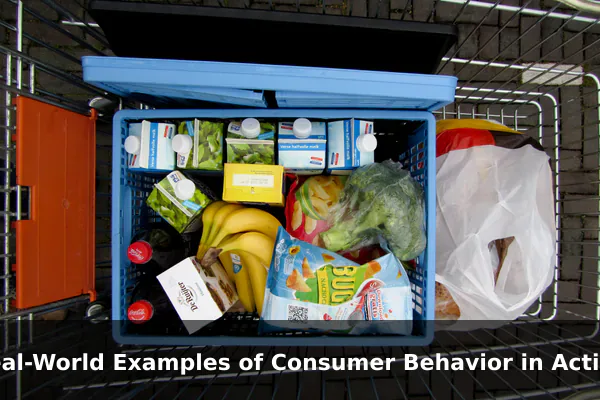
Abstract concepts become far more actionable when grounded in real behavior patterns that marketers encounter every day.
Impulse Buying
Retail environments are engineered to trigger impulse purchases. Candy placed at the checkout counter, limited-time banners on e-commerce pages, and flash-sale push notifications all target this behavior. Impulse buying is driven by emotion, low friction, and perceived urgency — not deliberate planning.
Brand Loyalty
Apple users rarely switch to Android. Harley-Davidson owners form communities built around the brand identity. Brand loyalty exists when a product becomes part of the consumer’s self-concept. Marketers build loyalty through consistent quality, emotional storytelling, and community — not discounts alone.
Price Anchoring
When a product is shown alongside a much more expensive option, the original price feels more reasonable. This is anchoring. Many SaaS companies use three-tier pricing for exactly this reason, making the mid-tier option feel like the obvious, sensible choice even if it is the most profitable for the business.
Seasonal and Event-Driven Behavior
Consumer behavior spikes around predictable events — back to school, the holiday season, major sporting events, Valentine’s Day. Brands that plan ahead and build campaigns around these peaks consistently outperform those that react late or miss them entirely.
How Marketers Can Use Consumer Behavior Insights
Translating behavioral knowledge into practical marketing strategy is where the real commercial value is created.
- Build behavior-based personas: Go beyond age and job title. Map personas by motivations, values, purchase triggers, and the specific anxieties that slow down decisions.
- Optimize the decision journey: Use analytics and session recordings to find where consumers drop off and improve those specific touchpoints — a slow checkout page, an unclear product description, or a confusing pricing structure.
- Use emotional triggers intentionally: FOMO, social validation, and aspiration are powerful creative tools when applied authentically and matched to the right audience.
- Personalize at scale: Use behavioral data to serve the right message to the right person at the right time — through email segmentation, retargeting ads, or dynamic web content.
- Test and validate assumptions: A/B testing, surveys, and customer interviews reveal whether behavioral assumptions match actual customer actions. Assumptions made without validation are expensive.
Common Mistakes When Interpreting Consumer Behavior
Even experienced marketers make errors when working with behavioral data and building strategies around it.
- Assuming rational decision-making: Most purchases are emotionally driven and later rationalized. Marketing that appeals only to logic often misses the real buying trigger entirely.
- Overgeneralizing from limited data: One focus group does not represent a market. Patterns need to be validated across multiple data sources before informing major decisions.
- Ignoring the post-purchase phase: Many brands focus entirely on acquisition and overlook the fact that a satisfied customer is both cheaper to retain and more likely to refer others.
- Using outdated personas: Consumer preferences shift. A persona built on data from three years ago may no longer reflect your actual buyer today. Refresh behavioral research regularly.
- Confusing correlation with causation: Sales rising during a campaign does not prove the campaign caused the lift. Control for external variables before attributing results to any single factor.
Consumer behavior is not a fixed formula — it is a living, shifting landscape shaped by psychology, personal circumstance, culture, and context. The brands that consistently outperform their competitors are those that stay genuinely curious about their customers, test their assumptions regularly, and adjust strategy based on what real behavior — not internal opinion — reveals.
Whether you are refining your messaging, redesigning a product page, or planning your next campaign, consumer behavior insights give you the clarity to make decisions that actually connect with the people you are trying to reach. Start by asking why your customers buy — and let that answer guide everything else.
