
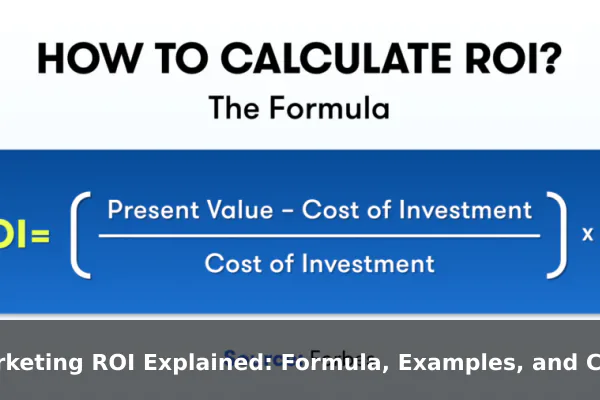
Marketing teams spend thousands of dollars on campaigns every month, yet many struggle to answer one simple question from leadership: was it worth it? Marketing ROI — return on investment — is the metric designed to answer exactly that. It translates campaign spending into a clear financial outcome, helping businesses decide where to put their next marketing dollar.
But ROI is deceptively simple. The formula looks straightforward, yet small errors in what you count as cost or return can produce wildly misleading numbers. A campaign that appears profitable on a spreadsheet might actually be bleeding margin once all costs are factored in. This guide walks you through the formula, real numeric examples, and the most common mistakes marketers make when calculating and reporting ROI.
Whether you manage paid ads, email campaigns, or content programs, understanding marketing ROI correctly is one of the most practical skills you can develop.
What Marketing ROI Actually Measures
Marketing ROI measures how much financial return a business earns relative to what it spends on marketing activities. It answers the fundamental question: did this campaign generate more value than it consumed?
At its core, ROI is a profitability signal. It is not a traffic metric, an engagement score, or a brand awareness indicator. When a team says their campaign delivered a 300% ROI, they mean that for every dollar invested, the campaign returned three dollars in profit above and beyond that initial cost.
Who Uses Marketing ROI
- Marketing managers use it to compare campaign performance across channels and justify channel investment.
- CFOs and finance teams use it to decide whether to expand or reduce the marketing budget.
- Agency clients use it to evaluate whether the fees they pay generate enough business value.
- Growth teams use it to identify which channels deserve more spend at scale.
When ROI Is Most Helpful
ROI is most reliable when you can directly link a marketing action to a revenue outcome. Direct-response campaigns, paid search, and email marketing are natural fits because purchases can be tracked back to a specific campaign. Brand awareness campaigns are harder to measure with ROI because the impact spreads across time and multiple touchpoints before it converts into a sale.
The Marketing ROI Formula Broken Down
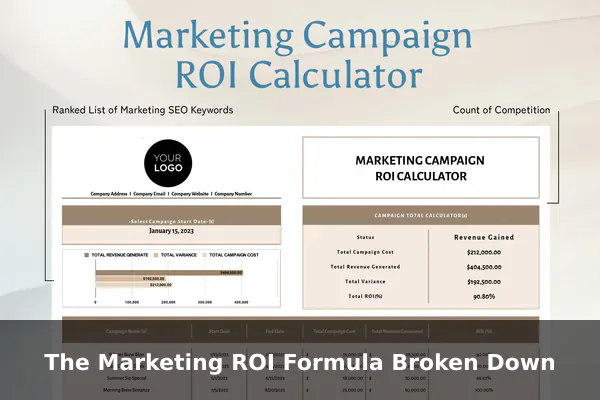
The standard marketing ROI formula is:
Marketing ROI = [(Revenue Attributed to Marketing – Marketing Cost) ÷ Marketing Cost] × 100
This gives you a percentage. A result of 100% means you doubled your investment. A result of 0% means you broke even. A negative result means the campaign cost more than it returned.
Defining Each Variable
Getting the formula right starts with defining your inputs precisely.
- Revenue attributed to marketing: The revenue tied back to a specific campaign or channel — not your total business revenue. This requires tracking or attribution tools.
- Marketing cost: Everything spent to run the campaign — ad spend, agency fees, tool subscriptions, creative production, and dedicated staff time. Missing costs inflate ROI artificially.
- Profit vs. revenue: Many analysts use gross profit instead of raw revenue. If a product costs $60 to produce and sells for $100, the gross profit is $40. Using gross profit gives a more honest ROI than using the full sale price.
Gross Return vs. Net Return
There are two common formula variants marketers use in practice.
- Gross ROI uses total revenue in the numerator. It is simpler to calculate but less accurate because it ignores the cost of goods or services sold.
- Net ROI substitutes gross profit for revenue. It requires more data but shows whether the campaign actually generated real margin above all costs.
For campaigns where product margins vary significantly across the catalog, net ROI is always the more honest choice for reporting to leadership.
Simple Marketing ROI Examples
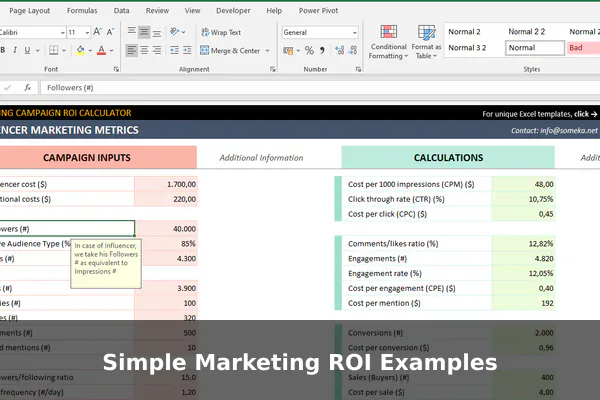
Walking through concrete numbers makes the formula far easier to apply. Here are three realistic examples across common marketing channels.
Example 1: Paid Search Campaign
A software company runs a Google Ads campaign for one month with the following numbers:
- Ad spend: $5,000
- Agency management fee: $750
- Revenue attributed: $22,000
- Cost of service delivery: $8,000
- Gross profit from the campaign: $14,000
ROI = [($14,000 – $5,750) ÷ $5,750] × 100 = 143%
For every dollar invested, the company earned $1.43 in profit above costs. That is a strong result for a paid search campaign where competition and cost-per-click are typically high.
Example 2: Email Marketing Campaign
An e-commerce brand sends a promotional email to 50,000 subscribers for a seasonal sale.
- Email platform cost (prorated): $200
- Copywriter fee: $300
- Revenue attributed: $8,000
- Product margin: 40% — gross profit equals $3,200
ROI = [($3,200 – $500) ÷ $500] × 100 = 540%
Email consistently shows high ROI because costs are low relative to revenue. Importantly, if the team had used $8,000 in revenue instead of $3,200 in profit, they would have reported a 1,500% ROI — impressive-looking but deeply misleading.
Example 3: Content Marketing
A B2B company invests in a long-form content program over six months.
- Total content spend — writers, SEO tools, design: $12,000
- Revenue attributed via lead tracking: $18,000
- Gross profit at 60% margin: $10,800
ROI = [($10,800 – $12,000) ÷ $12,000] × 100 = –10%
Negative ROI at six months. But content marketing often takes 12 to 18 months to compound through search rankings and repeat traffic. This is precisely why the measurement window matters so much — a point covered in detail in the mistakes section below.
Marketing ROI vs. ROAS and Other Metrics
Many teams confuse ROI with closely related metrics, particularly ROAS. They measure different things and should not be used interchangeably when making profitability decisions.
ROI vs. ROAS
ROAS, or Return on Ad Spend, measures revenue generated per dollar of ad spend using the formula ROAS = Revenue ÷ Ad Spend. A ROAS of 4x means $4 in revenue for every $1 spent on ads. But ROAS does not account for profit margins or the full cost of running a campaign. You can have a strong ROAS and still lose money if margins are thin and agency fees are high. ROI is more comprehensive — it factors in all costs and ties directly to profitability, not just revenue volume.
ROI vs. CAC
Customer Acquisition Cost tells you how much it costs to acquire one customer. It is useful for evaluating efficiency but does not reveal whether that acquisition cost justified the value the customer will generate over time. ROI pairs well with Customer Lifetime Value: if your CAC is $50 and LTV is $400, marketing ROI over the customer relationship will be strong even if short-term campaign ROI looks modest.
When to Use Which Metric
| Metric | Best Used For |
|---|---|
| Marketing ROI | Evaluating overall campaign profitability |
| ROAS | Optimizing paid advertising efficiency |
| CAC | Assessing the cost of growing your customer base |
| Conversion Rate | Measuring how well your funnel converts traffic |
Use ROI when making budget allocation decisions. Use ROAS when optimizing individual ad campaigns day to day. Use CAC when evaluating long-term acquisition strategy against customer lifetime value.
Common Mistakes That Skew ROI
Calculating marketing ROI looks easy but is frequently done incorrectly. These are the errors most likely to produce misleading numbers and poor strategic decisions.
Using Revenue Instead of Profit
The single most common mistake. If you sell $50,000 in products but it cost $35,000 to produce them, the actual marketing return is based on $15,000 in gross margin. Using $50,000 as the return in your formula inflates ROI dramatically and can make unprofitable campaigns look like clear wins on paper.
Leaving Out Full Campaign Costs
Teams often include ad spend but forget agency fees, creative production costs, software subscriptions, and the employee time spent managing and reporting on the campaign. Every cost directly associated with the campaign belongs in the denominator. Partial cost inputs produce falsely high ROI figures that will not survive scrutiny from a finance team.
Poor Attribution
Attribution — crediting a sale to the right marketing touchpoint — is one of the hardest problems in marketing analytics. Last-click attribution gives all credit to the final channel before purchase, which typically over-credits paid search and under-credits awareness content or email nurture sequences. If your attribution model is structurally wrong, your channel-level ROI figures will be wrong in the same direction every time.
Too Short a Measurement Window
Content, SEO, and email list building generate returns that grow for months or years. Measuring ROI for these channels at 30 or 60 days often shows negative or flat returns even when long-term ROI is excellent. Match your measurement window to the expected return cycle of each campaign type, not to your monthly reporting calendar.
Excluding Offline Impact
Campaigns running on digital channels can drive in-store purchases, phone inquiries, or word-of-mouth referrals that never appear in your analytics platform. Without call tracking, store-specific coupon codes, or post-purchase surveys, these outcomes are invisible to the ROI calculation — resulting in a systematic undercount of real campaign performance.
Ignoring Cannibalization
If a paid campaign captures customers who would have found you organically anyway, the true incremental revenue from that campaign is lower than raw attribution suggests. Incrementality testing — running controlled experiments with holdout groups — helps isolate real campaign lift from organic demand that would have converted regardless of the paid push.
How to Improve Marketing ROI
A low or negative ROI is not always a reason to cut a channel. Often the answer is improving how the campaign is structured, how costs are managed, or how budget is allocated across the mix.
Tighten Audience Targeting
Broad targeting wastes spend on users unlikely to convert. Using first-party data, behavioral signals, and refined audience segments to reach high-intent prospects reduces cost per acquisition and improves overall ROI without requiring a larger budget.
Improve the Conversion Path
Traffic that does not convert generates cost without return. Auditing your landing pages, checkout process, and lead capture forms for friction points can lift conversion rates meaningfully without increasing spend — which directly raises ROI on your existing campaigns. Small conversion rate improvements compound quickly across high-volume campaigns.
Invest in Retention
Retaining an existing customer is typically far less expensive than acquiring a new one. Email sequences, loyalty programs, and post-purchase campaigns can drive repeat revenue at a very low marginal cost, boosting the lifetime ROI of campaigns that already acquired those customers in an earlier period.
Test Creatives and Offers Continuously
A/B testing ad copy, visuals, offers, and calls to action can meaningfully improve conversion rates at the same budget level. A 20% improvement in conversion rate at flat spend translates directly into a proportional improvement in ROI for that campaign — no extra investment required.
Reallocate Budget Toward Higher-Margin Products
Not all products generate the same margin. Campaigns driving high-volume sales on low-margin products may show impressive revenue numbers but produce poor ROI. Shifting spend toward campaigns that promote higher-margin products or services is one of the most direct levers available for improving marketing ROI without changing overall budget levels.
A Quick Checklist for Reporting ROI Clearly
When presenting marketing ROI to leadership or clients, accuracy and context matter equally. A number without context can mislead just as effectively as a wrong number. Use this checklist to ensure your ROI reports tell the complete story.
Before calculating:
- Identify every cost associated with the campaign: ad spend, platform fees, creative, tools, and staff time
- Confirm whether you are using gross revenue or gross profit in the return figure
- Define the attribution model being applied: last click, first click, linear, or data-driven
- Set a measurement window appropriate to the campaign type and expected return cycle
In the report itself:
- State the exact formula used so readers can verify the math
- Show the full time period covered by the measurement
- List all cost inputs and where each number came from
- Note the attribution model applied and any known limitations of that model
- Include a clear caveat for any unmeasured offline impact or estimated cannibalization effects
For benchmarking and comparison:
- Benchmark against previous campaign periods or established channel averages
- Include ROAS or CAC for additional context where relevant for the audience
- Flag long-investment campaigns where short-term ROI is intentionally low by design
A transparent ROI report builds trust with leadership and helps your team make better decisions — not just about what performed well, but about why it performed that way and what should change next.
Conclusion
Marketing ROI is one of the most powerful tools available to a marketing team — and one of the most frequently misused. The formula itself is simple, but what you put into it determines whether the result reflects financial reality or simply makes a campaign look better than it deserves.
Using gross profit instead of raw revenue, accounting for every associated cost, choosing an appropriate attribution model, and matching the measurement window to the campaign type are the habits that separate reliable ROI reporting from misleading numbers. When you get the inputs right, marketing ROI becomes a genuine decision-making tool: it tells you what is working, what is not, and where your next dollar will generate the strongest return.
Start with the correct formula, verify every input, and always show your methodology when reporting to stakeholders. Marketing that can demonstrate its returns earns more resources — and that credibility, over time, is a return on measurement itself.
