

Most people think marketing means running ads or posting on social media. That narrow view is one of the biggest reasons small businesses struggle to grow. Marketing is something far bigger — it is the entire system a business uses to find the right customers, communicate genuine value, and build lasting relationships that lead to consistent sales.
Whether you are launching a brand from scratch or trying to grow an existing business, understanding how marketing truly works gives you a real competitive edge. This guide breaks it all down in plain English, covering everything from what marketing actually means to how you measure whether it is working. By the end, you will have a clear picture of the key building blocks — audience, value, channels, messaging, and measurement — and how they all connect.
What Marketing Actually Means
Marketing is the process of identifying the right people, understanding what they need, and clearly communicating why your product or service is the best solution. It is not just advertising, not just selling, and not just a logo and color palette. Those are pieces of a much larger system.
Here is how the key terms differ:
- Sales is the act of closing a deal — converting an interested person into a paying customer.
- Branding is how people perceive your business — your reputation, visual identity, and emotional associations.
- Advertising is paid communication designed to reach a defined audience.
- Marketing is the overarching strategy that connects all of these, starting with understanding your customer and ending with retaining them long-term.
Think of marketing as the engine of business growth. Without it, even the best product can go unnoticed. With a clear marketing strategy, a modest product can lead a market because the right people hear about it, understand it, and trust it enough to buy.
Why Marketing Works in the Real World
Marketing works because it is built on a fundamental truth about human behavior: people do not buy products, they buy solutions to problems. When a business deeply understands the specific problem its customers face, it can speak directly to that pain point in a way that feels personal and relevant.
The four pillars that make marketing effective are:
- Understanding the problem. The more precisely you can describe the customer’s frustration, the more your marketing will resonate with them.
- Offering real value. Your product must genuinely solve the problem. Marketing amplifies value — it does not manufacture it from thin air.
- Building trust. People buy from brands they trust. Consistent messaging, social proof, and helpful content all build that trust over time.
- Guiding decisions. Marketing creates a clear path that moves a person from not knowing you exist to choosing to buy from you.
A local bakery posting beautiful photos of fresh bread is doing marketing. A software company publishing helpful articles answering industry questions is doing marketing. In both cases, the business is connecting with the right audience and building the familiarity that eventually leads to a sale.
The Core Parts of a Marketing Strategy
Effective marketing does not happen by accident. It starts with a clear strategy that defines who you are trying to reach and exactly how you plan to reach them. Here are the essential elements every marketing strategy needs.
Target Audience
Before anything else, define exactly who your ideal customer is. Go beyond basic demographics like age and location. Understand their goals, frustrations, daily habits, and what motivates them to make a buying decision. The more specific your audience definition, the more effective and efficient your marketing becomes.
Market Research
Market research is how you gather real information about your audience, your competitors, and the broader landscape. This can be as simple as reading customer reviews, conducting short surveys, or studying what competitors communicate in their marketing. Research replaces guesswork with informed decisions.
Positioning and Messaging
Positioning answers the question: why should someone choose you over the competition? It is the unique space your brand occupies in a customer’s mind. Strong positioning is clear, believable, and tied directly to something the customer genuinely cares about. Your messaging is how that positioning is expressed in words.
Offer, Pricing, and Channels
Your offer is what you are selling and how it is packaged. Pricing signals value and shapes how customers perceive your brand. Channels are the places your marketing appears — social media, search engines, email, and more. Aligning all three ensures your message reaches the right person at the right time and place.
Common Marketing Channels Beginners Should Know
There are dozens of marketing channels available today, but beginners do not need to use all of them. Start by understanding what each major channel does best, then pick one or two that fit your audience and budget.
- Content Marketing: Creating valuable articles, videos, or podcasts that attract and educate your target audience. Best for building long-term authority and organic reach.
- SEO (Search Engine Optimization): Optimizing your website so it ranks in search results when people look for what you offer. Excellent for capturing high-intent traffic at low ongoing cost.
- Email Marketing: Sending targeted messages directly to a list of subscribers. One of the highest-ROI channels available, especially for nurturing leads and retaining existing customers.
- Social Media Marketing: Building an audience and engaging with customers on platforms like Instagram, LinkedIn, or TikTok. Best for brand awareness, community building, and direct engagement.
- Paid Advertising: Running ads on Google, Facebook, or other platforms to reach a targeted audience quickly. Useful for fast results, but requires ongoing spend to maintain visibility.
- Word-of-Mouth and Referrals: Encouraging existing customers to share your business with others. Often the most trusted form of marketing and can be amplified with a simple referral program.
The right channel depends entirely on your audience. A B2B software company will find LinkedIn and SEO more effective than TikTok. A fashion boutique targeting younger shoppers may see far better results on Instagram. Always let your audience’s habits guide your channel choice.
How a Simple Marketing Funnel Moves People to Buy
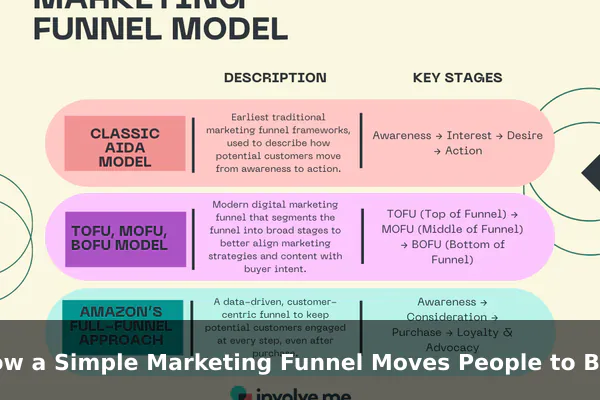
A marketing funnel is a model that describes the journey a customer takes from first discovering your brand to becoming a loyal buyer. Understanding this journey helps you create the right message and content for each stage rather than pushing the same message to everyone.
Awareness
At this stage, the customer does not know you exist. Your goal is to get in front of them through content, ads, social media, or search results. The message here should educate or entertain — this is not the place for a hard sell.
Interest and Consideration
The customer now knows about you and is evaluating whether your solution fits their needs. Blog posts, free guides, case studies, testimonials, and free trials all work well at this stage. Help them make an informed decision in your favor by showing real results and reducing perceived risk.
Conversion
This is where the sale happens. A clear call-to-action, a frictionless checkout or sign-up process, and confidence-building elements like guarantees or visible reviews are critical. Remove every obstacle between interest and purchase.
Retention
Getting a customer to buy once is good. Getting them to buy again — and recommend you to others — is the real goal. Post-purchase emails, loyalty programs, excellent customer service, and community building all contribute to long-term retention and higher lifetime value.
How Businesses Measure Marketing Success
You cannot improve what you do not measure. Fortunately, you do not need to track dozens of numbers. Focus on a handful of meaningful metrics that connect directly to business growth.
- Website Traffic: The number of visitors your site receives, useful for understanding the reach of your content and campaigns.
- Lead Generation: How many people take an action showing genuine interest, such as signing up for a newsletter or requesting a consultation.
- Conversion Rate: The percentage of visitors or leads who complete a desired action such as making a purchase. This is one of the most important marketing numbers you can track.
- Customer Acquisition Cost (CAC): How much you spend to acquire one new customer. Keeping this number lower than the lifetime value of that customer is the formula for sustainable growth.
- Retention Rate: The percentage of customers who continue to buy from you over time. Retained customers are more profitable, easier to serve, and more likely to refer others.
Common Marketing Mistakes to Avoid
Beginners consistently make the same few mistakes when starting out. Understanding these pitfalls in advance saves significant time, money, and frustration.
Trying Every Channel at Once
Spreading effort across every platform leads to mediocre results everywhere. Pick one or two channels, master them, and only expand after you see consistent results. Depth beats breadth, especially early on.
Vague or Unclear Messaging
If your audience cannot immediately understand what you do, who it is for, and why it matters, they will move on. Your marketing message should be specific, focused on the customer’s problem, and free of jargon or generic claims.
Ignoring Data
Many businesses run campaigns and never review the results. Even a quick monthly review of your key metrics can reveal what is working and where you are wasting resources. Make data review a regular habit, not an occasional activity.
Expecting Overnight Results
Organic channels like content marketing and SEO take months to build momentum. Set realistic expectations and focus on consistency rather than chasing rapid results. Businesses that stay patient and persistent almost always outperform those that give up too soon.
A Simple Way to Start Marketing Effectively
If you are just getting started, the following framework gives you a clear, manageable path to follow without feeling overwhelmed by all the options available.
- Define your audience. Write a short description of your ideal customer, including their main problem, what they want, and where they spend time online.
- Clarify your value proposition. Complete this sentence: We help [audience] achieve [desired outcome] by [your unique approach]. This becomes the foundation of all your messaging.
- Choose one primary channel. Based on where your audience spends time, select one channel to focus on for the next 90 days and commit to showing up consistently.
- Create helpful content. Develop content that speaks directly to your audience’s questions and problems. Prioritize genuine usefulness over promotional language.
- Track one or two key metrics. Decide in advance how you will measure success, check your numbers monthly, and adjust based on what you learn.
- Test, learn, and improve. Marketing is not a set-and-forget activity. Run small experiments, measure the outcomes, and continuously refine your approach.
This simple loop — define, message, channel, create, measure, improve — is the core cycle of effective marketing. Businesses that follow it consistently, even imperfectly, will always outperform those that either do nothing or try everything at once without a clear plan.
Conclusion
Marketing is not a mystery reserved for large companies with big budgets. At its core, it is a practical discipline built around understanding people, communicating value clearly, and creating relationships that lead to trust and lasting sales. Every business, regardless of size or industry, can benefit from applying even the most basic marketing principles starting today.
Start simple. Know your audience, sharpen your message, pick one channel, and measure what matters. As you build confidence and see results, layer in more channels and more advanced tactics. The most important realization is this: marketing is a system, not a guessing game — and now you understand how that system works.
