
Marketing has always been about attracting and keeping customers, but the way businesses do that has split into two very different schools of thought. Growth marketing focuses on rapid experimentation and measurable outcomes across the entire customer lifecycle. Traditional marketing leans on proven brand-building channels and broad audience reach. Understanding the difference helps you allocate budget wisely and pick the strategy that actually fits your business stage and goals.
Whether you are launching a startup, running a local shop, or managing an established brand, choosing between growth and traditional marketing — or knowing when to blend them — can determine how fast you scale and how long your customers stay. This article breaks down both approaches, shows how each works in practice, and gives you a clear framework for choosing the right path.
What Growth Marketing and Traditional Marketing Actually Mean
Growth marketing is a data-driven, full-funnel approach that treats every stage of the customer journey — from first click to long-term loyalty — as an opportunity to test, learn, and improve. It borrows techniques from product development such as rapid iteration and A/B testing and applies them to acquisition, activation, retention, and referral. The goal is sustainable, measurable growth, not just traffic.
Traditional marketing, by contrast, prioritizes reach and brand awareness through established channels: television commercials, print ads, radio spots, billboards, and event sponsorships. Campaigns tend to be planned months in advance, run for a fixed period, and measured through sales lift or recall surveys rather than real-time analytics. The goal is to build broad recognition and trust over time.
The Core Mindset Difference
- Growth marketing asks: “What small change can we test today to improve conversions or retention?”
- Traditional marketing asks: “How do we create a campaign that puts our brand in front of the largest possible audience?”
The Key Differences at a Glance
Comparing these two approaches side by side makes the distinctions concrete and actionable for any marketing team.
- Goals: Growth marketing targets measurable KPIs such as customer acquisition cost, lifetime value, and churn rate. Traditional marketing targets awareness and brand recall.
- Channels: Growth uses email, paid search, SEO, in-app messaging, and referral programs. Traditional uses TV, radio, print, outdoor advertising, and events.
- Data use: Growth marketing runs continuous experiments with real-time data. Traditional campaigns rely on pre-launch research and post-campaign surveys.
- Speed: Growth marketers can launch and kill tests within days. Traditional campaigns often take months to plan and execute.
- Budget style: Growth marketing scales spending based on what works. Traditional marketing allocates large fixed budgets upfront.
- Customer focus: Growth marketing covers acquisition through retention. Traditional marketing focuses heavily on top-of-funnel awareness.
How Growth Marketing Works in Practice
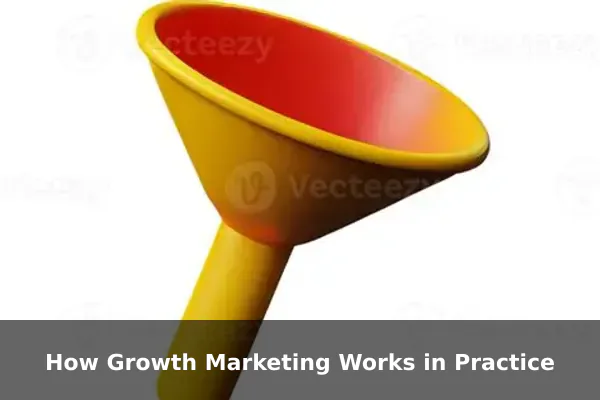
Growth marketers operate in short, iterative cycles. A typical workflow involves identifying a bottleneck in the funnel — say, low email open rates — forming a hypothesis, running an A/B test, reading the results, and rolling out the winner. This loop repeats constantly across every customer touchpoint.
Common Growth Marketing Tactics
- Funnel optimization: Improving landing pages, onboarding flows, and checkout processes to reduce drop-off at each step.
- Personalization: Sending behavior-triggered emails or showing dynamic content based on user actions and preferences.
- Referral programs: Turning satisfied customers into a distribution channel, similar to Dropbox’s model of rewarding users who invite friends.
- Retention campaigns: Win-back emails, loyalty rewards, and usage nudges designed to reduce churn and extend customer lifetime value.
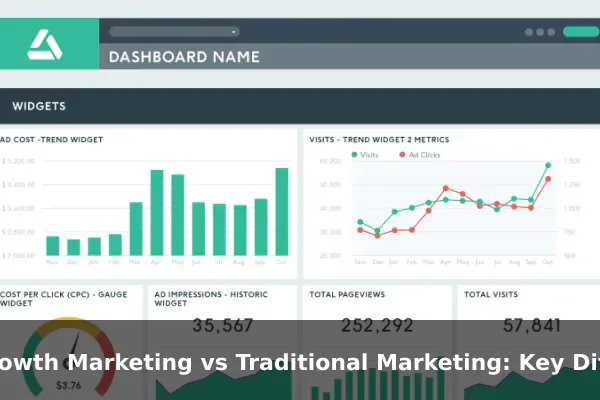
- Performance tracking: Real-time dashboards monitoring cost per acquisition, activation rate, and monthly recurring revenue.
Because growth marketing measures every step, teams can quickly drop what is not working and double down on what is — making it capital-efficient for businesses with limited budgets or high competition.
How Traditional Marketing Works in Practice
Traditional marketing excels at creating familiarity and trust with a wide audience, particularly when that audience is not yet actively searching for your product. A well-placed TV spot, a magazine spread in the right publication, or a sponsorship of a popular local event can embed a brand into the public consciousness in ways digital channels often cannot replicate at scale.
Common Traditional Marketing Tactics
- Television and radio advertising for mass demographic reach
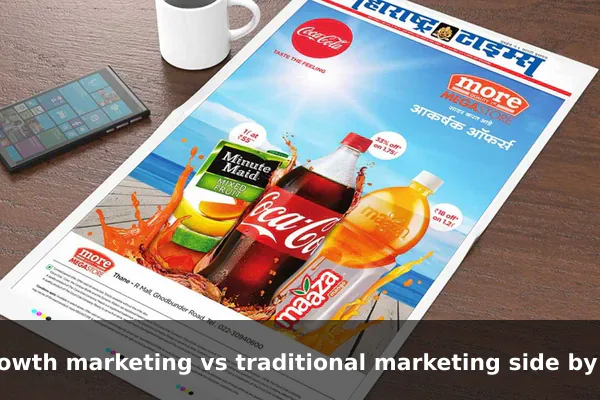
- Print ads in newspapers and industry trade magazines
- Direct mail campaigns targeted to postal lists
- Outdoor advertising including billboards and transit placements
- Trade show and event sponsorships for face-to-face brand exposure
- Public relations and earned media through press and journalists
The trade-off is measurement precision. Brand lift studies and sales correlation analysis are less exact than click-through rates. However, for products with broad appeal or categories where credibility is paramount — such as healthcare, financial services, or luxury goods — traditional channels often remain essential and irreplaceable.
When Each Approach Makes the Most Sense
Neither approach wins in every situation. The right choice depends on your business stage, audience, budget, and goals.
Choose Growth Marketing When You Are
- A startup or early-stage business with a tight budget and a need to prove unit economics quickly
- Running a SaaS, e-commerce, or app-based business where user behavior is fully trackable
- Focused on customer retention and lifetime value as much as new acquisition
- Willing to run frequent experiments and iterate rapidly based on live data
Choose Traditional Marketing When You Are
- An established brand reinforcing recognition across a broad geographic or demographic market
- Operating in an industry where offline trust signals such as print and broadcast matter significantly
- Launching a product to an audience that is not yet online or not actively searching for solutions
- Investing in long-term brand equity rather than immediate conversion volume
Can Businesses Combine Growth and Traditional Marketing?
Yes — and many successful brands do exactly that. A hybrid strategy uses traditional channels to build broad awareness and growth marketing tactics to convert that awareness into measurable action. For example, a national TV campaign drives branded search volume, while a well-optimized paid search funnel and landing page capture and convert that traffic efficiently.
The key to a hybrid approach is alignment. Brand messaging across TV, print, and outdoor must match the tone and value proposition of your email sequences, landing pages, and retargeting ads. Inconsistency between the two layers erodes trust rather than compounding it.
Common Mistakes When Choosing Between the Two
- Treating it as binary: Most mature businesses need elements of both approaches. Picking one and ignoring the other entirely is rarely the optimal strategy.
- Chasing short-term metrics only: Optimizing purely for clicks and conversions can hollow out brand equity over time and make customer acquisition more expensive.
- Ignoring retention: Growth marketing without a retention strategy simply fills a leaky bucket and wastes acquisition spend.
- Underestimating traditional reach: Dismissing TV or print because they seem outdated ignores their continued effectiveness for broad awareness and trust-building at scale.
- Running untested assumptions: Launching expensive traditional campaigns without any prior data validation wastes budget that could first be tested and validated through lower-cost digital experiments.
Which Marketing Approach Should You Choose?
Start with your business goals and work backwards. If you need to prove that your product acquires and retains customers efficiently, prioritize growth marketing tactics. If you need to create category awareness in a market that does not yet recognize your product exists, traditional marketing or a dedicated brand-building budget may be unavoidable.
For most businesses today, the most practical framework looks like this: use growth marketing tactics to find what messaging, channels, and offers convert best, then amplify those proven messages through broader traditional channels once the budget allows. This approach reduces risk, improves return on investment, and ensures that brand-level investment is built on validated insights rather than gut instinct.
The most effective marketers are not loyalists to one school of thought. They understand the strengths and limits of both approaches, and they build strategies that combine disciplined experimentation with the long-term brand investments that sustain customer trust and competitive advantage over time.
