
More than half of all web traffic now comes from smartphones. That single fact has changed the way businesses plan and execute marketing campaigns. Mobile marketing is no longer an optional layer on top of a broader strategy — it is often the strategy itself.
This guide breaks down what mobile marketing actually means, which channels deserve your attention, and how real-world examples can help you choose the right approach for your goals. Whether you are starting from scratch or sharpening an existing campaign, the following sections give you a practical foundation without the theory overload.
What Mobile Marketing Means Today
Mobile marketing is the practice of reaching customers on their smartphones and tablets through targeted messages, ads, apps, and experiences. While digital marketing covers every screen and device, mobile marketing focuses specifically on the small screen where people spend an increasing share of their daily time.
Unlike desktop browsing, mobile usage tends to be fast, intent-driven, and location-aware. A person searching for a nearby coffee shop or checking a flash sale notification is in a very different mindset than someone sitting at a laptop doing research. Mobile marketing works best when it respects that context and meets users where they already are.
Why Mobile Marketing Matters for Business Growth
The case for mobile marketing comes down to a few hard-to-ignore advantages:
- Reach: Billions of people carry smartphones, giving marketers access to audiences that are unreachable through traditional channels alone.
- Engagement: Mobile notifications and messages see significantly higher open rates than desktop alternatives.
- Personalization: Location data, app behavior, and browsing history allow precise audience targeting.
- Speed: Mobile campaigns can go live quickly and drive near-instant responses, especially for time-sensitive offers.
- Local relevance: Geolocation tools make it possible to deliver offers to users within a specific radius of a physical store.
For small businesses especially, mobile marketing levels the playing field by enabling targeted, cost-effective campaigns without the budgets required for traditional advertising.
Key Mobile Marketing Channels to Know
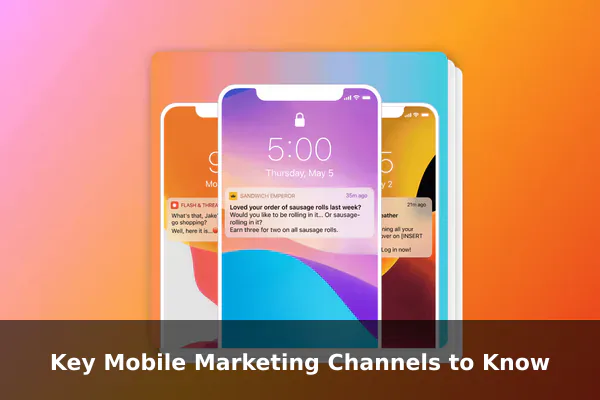
Mobile marketing is not a single tool — it is a collection of channels, each suited to different goals and audiences. Here is an overview of the most important ones.
SMS Marketing
Short message service (SMS) marketing delivers text messages directly to a customer’s phone. Open rates for SMS routinely exceed 90 percent, making it one of the most reliable ways to get a message seen quickly. It works best for time-sensitive offers, appointment reminders, and transactional alerts.
Mobile Email
Over half of all emails are now opened on a mobile device. A well-designed mobile email uses a single-column layout, large readable fonts, and clear call-to-action buttons that are easy to tap. The channel suits newsletters, promotional offers, and nurture sequences.
Social Media Ads
Platforms like Instagram, TikTok, and Facebook are built around mobile use. Their ad formats — stories, reels, carousels — are designed for the vertical screen and short attention span. Social ads are effective for brand awareness, product launches, and retargeting warm audiences.
Mobile Search Ads
When users search on their phones, they often see ads at the top of results. Google call-only ads, for example, let a user tap to call a business directly from the search results page — no website visit required. These ads work well for local services and high-intent queries.
In-App Advertising
Apps display banner ads, interstitials, and rewarded video ads within the user experience. If your target audience regularly uses specific apps, in-app advertising places your message in front of them in a context they have already chosen to engage with.
Push Notifications
Apps and mobile websites can send push notifications to users who have granted permission. These short messages appear on the lock screen or notification tray and can bring users back to an app or website without requiring them to open anything first.
Location-Based Marketing
Geofencing and beacon technology allow businesses to send offers or messages when a user enters a defined geographic area. A retail store, for example, can send a discount code when a loyalty member walks within a block of the location during business hours.
Helpful Examples of Each Channel in Action
Abstract descriptions are easier to apply when paired with concrete examples. Here is how each channel looks in a real campaign setting.
- SMS: A clothing retailer sends a text at 10 a.m. on Saturday: “Flash sale — 30% off everything today only. Shop now: [link].” The time-sensitive nature and high open rate drive immediate traffic to the sale page.
- Mobile email: A software company sends a mobile-optimized email with a single bold button: “Start Your Free Trial.” The layout renders cleanly on any screen size and removes friction from the signup process.
- Social media ad: A fitness app runs a vertical video on Instagram Stories showing a 30-second workout demo, followed by a “Download Free” button. The format feels native to the platform rather than disruptive.
- Mobile search ad: A local plumber runs a call-only Google ad targeting users who search “emergency plumber near me.” The customer taps the ad and calls directly — faster than visiting any website.
- In-app ad: A recipe app displays a short video from a kitchen appliance brand. Users who watch the full clip receive a discount code redeemable on the brand’s mobile site.
- Push notification: An e-commerce app sends: “You left items in your cart — complete your order and save 10%.” The reminder consistently converts abandoned carts at a measurable rate.
- Location-based: A coffee chain sends a push notification with a free pastry offer when a loyalty member is detected within 200 meters of a branch during the morning commute window.
How to Choose the Right Channel for Your Goal
Matching the channel to the objective prevents wasted budget and improves campaign results. Here is a quick reference:
- Brand awareness: Social media ads and in-app advertising reach large audiences passively without requiring prior intent.
- App installs: Social ads with direct app store links and mobile search ads target users already looking for apps in your category.
- Repeat purchases: Push notifications and SMS are effective for existing customers who already trust the brand.
- Lead generation: Mobile email and social lead-form ads collect contact details without requiring users to leave the platform.
- Local foot traffic: Location-based campaigns and mobile search ads capture high-intent users near the physical business.
- Customer retention: Personalized push notifications and loyalty SMS programs keep existing users engaged over time.
Mobile Marketing Best Practices That Improve Results
Choosing the right channel is only half the equation. Execution determines whether the campaign converts or gets ignored.
- Design for the small screen first. Every landing page, email, and ad should render properly on a narrow screen before being adapted for larger devices.
- Write short, direct copy. Mobile users scan quickly. Lead with the offer rather than the backstory.
- Use a single, obvious call to action. One button per message removes decision fatigue and makes the next step clear.
- Segment your audience. Relevant messages consistently outperform broad blasts across every mobile channel.
- Respect timing. Sending a push notification at 2 a.m. without good reason erodes trust and increases opt-out rates.
- Collect proper consent. SMS and push notifications require explicit opt-in. Handling consent correctly protects users and keeps your business compliant.
- Test before scaling. Run A/B tests on message copy, timing, and offers before committing your full audience.
Common Mobile Marketing Mistakes to Avoid
Even well-funded campaigns underperform when basic errors go uncorrected.
- Over-messaging: Too many notifications push users to unsubscribe. Frequency caps protect long-term list health.
- Poor targeting: Blasting an offer to every contact without segmentation wastes budget and irritates recipients who have no interest in the offer.
- Non-responsive landing pages: Driving mobile ad traffic to a desktop-only page breaks the experience and kills conversions before they happen.
- Vague calls to action: “Check us out” is not a call to action. Specific, clear offers — discounts, free trials, limited-time deals — consistently outperform vague invitations.
- Ignoring privacy signals: Users who feel their data is being used without clear consent respond with opt-outs, negative reviews, and lost trust.
How to Measure Mobile Campaign Performance
Measurement closes the loop between effort and outcome. The following metrics apply broadly across most mobile channels:
- Click-through rate (CTR): The percentage of recipients who tapped the link or button. Low CTR usually points to weak copy or poor targeting.
- Open rate: Relevant for SMS and mobile email. High open rates indicate a trusted sender and a relevant subject line or preview text.
- Conversion rate: The share of users who completed the desired action — a purchase, signup, or download. This is the ultimate measure of campaign effectiveness.
- App retention rate: For push notification campaigns, how many users remain active 30 days after installing the app.
- Return on ad spend (ROAS): Revenue generated for every dollar spent. Use this figure to compare channel performance and reallocate budget toward what works.
- Cost per install (CPI): For app promotion campaigns, the average cost to acquire each new user install.
Track these metrics from launch, compare them across channels, and revisit your strategy regularly to adjust based on what the data actually shows rather than assumptions.
Conclusion
Mobile marketing gives businesses a direct line to customers who spend hours each day on their phones. Understanding the channels — from SMS and push notifications to social ads and location-based campaigns — is the first step toward building campaigns that perform consistently.
Start with one or two channels that match your current goals, measure the results carefully, and expand from there. The most effective mobile marketing programs are built through iteration and learning, not guesswork. With the right channel, the right message, and the right timing, even a modest campaign can drive meaningful business results.
