
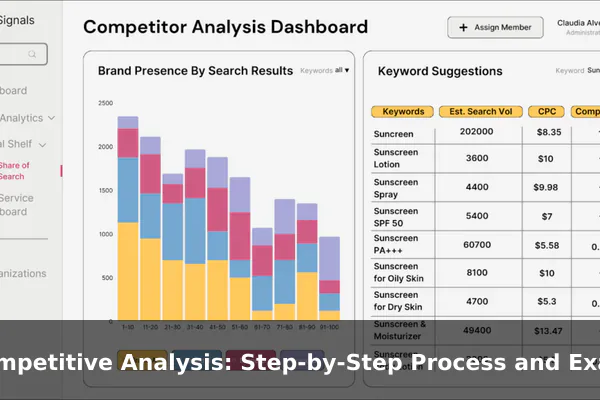
Competitive analysis is one of the most practical marketing exercises a business can run because it turns vague market pressure into clear evidence. Instead of guessing why a rival ranks higher, converts better, or earns more trust, you study what customers actually see: the offer, the message, the pricing logic, the channels, and the overall experience. The goal is not to obsess over competitors. The goal is to make better decisions about your own positioning and growth.
Many businesses either skip this work or do it too loosely. They collect random screenshots, note a few prices, and call it competitor research. That usually creates noise, not insight. A useful competitive analysis follows a repeatable process: identify the right competitors, gather the same categories of information for each one, compare patterns, and turn those patterns into specific marketing actions.
This guide walks through that process from start to finish. You will learn what competitive analysis means in a marketing context, what to measure, how to build a simple framework, and how to use the results to improve messaging, content, SEO, pricing communication, and channel strategy. You will also see a realistic small business example so the process feels actionable rather than theoretical.
What Competitive Analysis Means in Marketing
In marketing, competitive analysis is the structured process of comparing your business with other companies that compete for the same customer attention, budget, or demand. It helps you understand how the market is positioned today and where your brand can stand apart.
A strong analysis does more than list competitor features. It explains how competitors attract interest, what promises they make, what audiences they speak to, and why a buyer might choose them over you. That makes it a decision-making tool for positioning, campaign planning, and product communication.
Direct, indirect, and aspirational competitors
Not every competitor belongs in the same bucket. Separating them improves focus.
- Direct competitors sell a similar solution to a similar audience. These are the businesses most likely to appear in the same search results, pitch decks, or customer shortlists.
- Indirect competitors solve the same problem in a different way. They may not look similar on the surface, but customers still compare you with them when deciding how to spend money.
- Aspirational competitors may be larger, more mature, or slightly outside your segment, but they set a standard for messaging, user experience, or brand perception worth studying.
For example, a small email automation tool may compete directly with other lightweight platforms, indirectly with general CRM software, and aspirationally with a category leader known for excellent onboarding and content.
When businesses should run a competitive analysis
Competitive analysis is valuable before a launch, during a rebrand, when growth stalls, or when the market starts shifting. It is also useful when organic rankings change, conversion rates drop, paid campaigns become more expensive, or customers repeatedly mention the same alternatives during sales calls.
In short, use competitive analysis whenever you need clarity on your market position. It helps answer questions such as these:
- Are we targeting the right audience segment?
- Does our value proposition sound distinct or generic?
- Are competitors winning because of price, trust, convenience, or visibility?
- Which channels matter most in this category?
- What market gap can we own instead of copying the loudest brand?
What to Measure Before You Start
Before collecting data, decide what you are comparing. Without fixed categories, a competitive analysis becomes a pile of disconnected observations. The best approach is to define a consistent checklist and use it for every competitor.
Core comparison areas
Most marketing teams should review these areas first:
- Target audience: Who does the competitor seem to serve? Beginners, professionals, budget buyers, enterprise teams, local customers, or niche communities?
- Offer and product scope: What exactly is being sold, and how broad or narrow is the solution?
- Pricing and packaging: Is the offer framed as affordable, premium, flexible, or all-inclusive?
- Positioning and messaging: What claims appear in headlines, hero sections, ads, and taglines?
- Content and SEO footprint: What topics do they target, what keywords are visible, and how educational is their content?
- Social media presence: Which platforms matter most, what themes repeat, and what type of engagement shows up?
- Proof and credibility: Do they use reviews, testimonials, case studies, certifications, or customer counts?
- Customer experience: How easy is it to understand the offer, start a trial, request a quote, or make a purchase?
- Promotions and retention tactics: Do they push bundles, discounts, upsells, or lifecycle emails?
You do not need to measure everything in extreme detail. What matters is choosing the dimensions most relevant to your business model and marketing goal.
Start with a clear objective
The smartest competitive analysis begins with one question, not ten. A few examples:
- Why are competitors outranking us for high-intent search terms?
- How should we position a new service without sounding interchangeable?
- What pricing narrative is common in the category, and where can we be clearer?
- Which content themes are driving trust for competing brands?
Your objective shapes the depth of the analysis. If you are preparing a website relaunch, messaging and conversion paths deserve more attention. If you are planning SEO growth, competitor content structure, topical coverage, and search visibility deserve more attention.
Step 1: Identify Your Real Competitors
The first step is deceptively important. If you analyze the wrong companies, the rest of the work becomes misleading. Many businesses either choose only famous brands or include every company in the category. Neither approach is useful.
Build a focused competitor list
A practical list usually includes between three and seven competitors. That is enough to reveal patterns without making the project unmanageable.
- List the companies prospects mention in calls, chats, demos, or inquiries.
- Search the main problems your product solves and note which brands appear repeatedly.
- Search category terms, comparison terms, and purchase-intent phrases related to your offer.
- Review marketplaces, directories, review platforms, and social conversations in your niche.
- Separate each company into primary, secondary, or aspirational groups.
This creates a shortlist that reflects the real buying environment rather than a theoretical one.
How to avoid a distorted list
Be careful with edge cases. A business with massive traffic may not be your real competitor if it serves a completely different audience. Likewise, a local or niche rival with lower visibility may be extremely relevant if buyers compare you with them at the decision stage.
A useful rule is this: include competitors that influence customer choice, not just competitors that impress you. That keeps the analysis grounded in revenue reality.
A simple competitor mix
For many businesses, the most useful mix looks like this:
- Two or three direct competitors you lose deals to most often
- One or two indirect competitors that solve the same problem differently
- One aspirational competitor worth studying for execution quality
This structure makes it easier to compare similar offers while still learning from broader market behavior.
Step 2: Gather Competitor Data Systematically

Once the list is final, start collecting evidence in a structured way. The key word is systematically. Use the same checklist, the same note format, and the same level of scrutiny for each competitor.
Best places to collect data
You can gather meaningful competitor data without expensive tools. Start with publicly visible sources:
- Websites and landing pages: Review headlines, value propositions, navigation, FAQs, CTAs, pricing pages, and product detail pages.
- Search results: See which pages rank for category and problem-based keywords, and note titles, meta descriptions, and content angles.
- Paid ads: Observe search ads, display messaging, and social ad themes if visible through ad libraries.
- Social profiles: Check posting frequency, recurring content formats, engagement style, and brand voice.
- Email and newsletter flows: Sign up where appropriate to study onboarding, promotions, and follow-up cadence.
- Review sites and testimonials: Pay close attention to repeated praise and repeated complaints.
- Videos, webinars, and demos: These often reveal the most important product claims and audience assumptions.
- Customer-facing materials: Download guides, pricing PDFs, brochures, or comparison pages when available.
As you collect data, save examples, not just conclusions. A note that says messaging feels premium is weaker than a saved headline that proves it.
Use evidence instead of assumptions
Competitive analysis becomes unreliable when opinions replace observations. Instead of writing broad labels, capture details such as:
- Main homepage promise
- Top three benefits repeated across pages
- Visible price anchors or discount structures
- Content topics covered most often
- Most common review themes
- Primary CTA and secondary CTA
- Trust signals placed near conversion points
This gives you material you can compare later without relying on memory.
Keep your notes organized
Create one document or spreadsheet with the same fields for every competitor. If several people are involved, agree on definitions before starting. For example, define what counts as strong proof, high clarity, or weak differentiation so the notes remain consistent.
An organized record also makes future updates easier. Competitive analysis is not a one-time project. It becomes far more valuable when the same framework is revisited over time.
Step 3: Build a Simple Competitive Analysis Framework
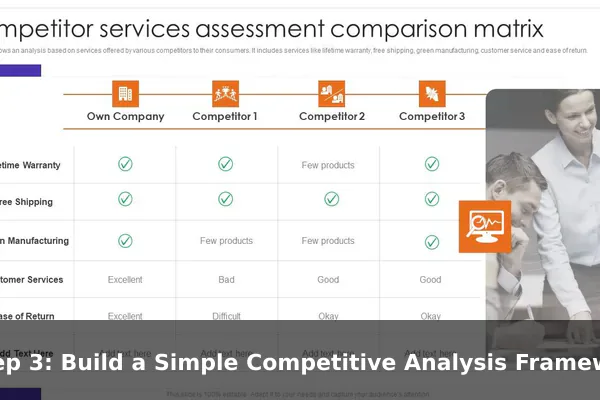
After you collect the raw information, turn it into a comparison framework. This is where scattered research becomes usable strategy.
What your framework should include
A simple competitive analysis matrix can include rows for the categories you care about and columns for each competitor, plus your own brand. Typical rows include:
- Audience segment
- Core offer
- Price position
- Main value proposition
- Brand tone
- Primary acquisition channels
- SEO content depth
- Social proof strength
- Conversion path clarity
- Unique differentiator
Including your own company is important. Without that column, you can compare rivals but still fail to see your position in the market.
Choose simple scoring logic
Some teams like descriptive notes only. Others prefer light scoring. Both can work, but simple scoring usually makes patterns easier to spot. Use a scale such as low, medium, and high, or a basic one-to-three system.
Avoid false precision. A competitor is not objectively a 7.4 out of 10 in messaging clarity. The point is to identify relative strengths and weaknesses, not pretend the analysis is scientific down to decimals.
Look for contrast, not perfection
The framework should help answer practical questions:
- Who is competing hardest on price?
- Who owns the premium or expert position?
- Who produces the most educational content?
- Who has the clearest onboarding path?
- Who relies heavily on social proof?
- Where does our brand sound too similar to everyone else?
When those contrasts become visible, strategy gets easier. You can see where the market is crowded, where the language is repetitive, and where customer needs may be underserved.
Step 4: Spot Strengths, Weaknesses, Gaps, and Opportunities
This step is where insight begins. A competitive analysis is only valuable if it leads to interpretation. You are not just filling in boxes. You are identifying what the market rewards, what it ignores, and where your business can win.
Find recurring strengths and weaknesses
Read across the matrix instead of down it. If multiple competitors repeat the same benefit, that benefit probably matters to buyers. If several brands have confusing pricing or weak trust signals, that may be a category-wide weakness you can exploit.
Common patterns to watch for include:
- Everyone targets broad audiences but nobody speaks clearly to a niche
- Competitors push features heavily but explain outcomes poorly
- Most brands publish content, but few connect content to conversion
- Reviews praise convenience but criticize support or onboarding
- Pricing pages exist, but the value logic behind pricing is unclear
Search for whitespace in the market
The most useful outcome of competitor analysis is often a gap. A gap does not always mean an untouched category. More often, it means an under-served angle, audience, or message.
You may discover that competitors speak mostly to advanced users while beginners feel intimidated. Or you may notice that every rival competes on features while none emphasize speed, ease, local expertise, or transparent service. That is the kind of opening that can sharpen marketing quickly.
Do not copy what looks successful
One of the biggest mistakes in competitor analysis is imitation without context. A tactic may work for a rival because of brand equity, budget, product depth, or audience fit. Copying the visible surface without understanding the business behind it often leads to weak results.
Instead of asking, What are they doing that we should copy? ask better questions:
- Why might this message work for their audience?
- What customer concern is this page trying to reduce?
- What do buyers likely understand immediately from this experience?
- Can we solve the same need in a more focused or credible way?
That mindset keeps the analysis strategic instead of reactive.
Step 5: Turn Insights Into Marketing Actions
This is the step many teams skip. They complete the competitor analysis, share a document, and move on. That wastes the entire exercise. Insights only matter when they change decisions.
Use findings to improve positioning and messaging
If every competitor sounds similar, clarity becomes an advantage. Rewrite your homepage headline, service page intros, or campaign copy so they answer three things faster than rivals:
- Who the offer is for
- What problem it solves
- Why it is different or easier to trust
If your research shows that competitors lead with broad claims, a more specific promise can help you stand out. If competitors focus on features, you may win with outcome-led language. If competitors sound corporate, a simpler human tone may create contrast.
Use findings to guide content and channel strategy
Competitive analysis can also reveal content opportunities. If rivals rank for general educational terms but ignore high-intent comparison topics, that is an opening. If they publish frequently on social media but drive weak engagement, you may not need to match volume. You may need a sharper angle.
Actions can include:
- Building content around unanswered customer questions
- Creating comparison pages for decision-stage search intent
- Improving metadata and content structure on priority pages
- Shifting budget toward channels that competitors underuse
- Testing new creative themes that address overlooked objections
Use findings to strengthen pricing communication and conversion paths
Competitive analysis is not just about traffic. It also affects conversion. If competitors hide pricing, your transparency may become a trust signal. If their pricing looks simpler, your own packaging may need clearer naming or better explanation.
Likewise, if competitor pages reduce friction with demos, FAQs, proof blocks, or strong guarantee language, consider how your own conversion path handles uncertainty. Customers rarely compare brands on one factor alone. They compare the total confidence each brand creates.
Create an action list with owners and timelines
To keep the work practical, turn findings into a short roadmap. For each action, assign:
- The change to make
- The reason based on research
- The owner
- The priority level
- The metric to watch
- The review date
That simple step transforms competitor research from documentation into execution.
Competitive Analysis Example for a Small Business
Imagine a small direct-to-consumer skincare brand preparing to launch a new vitamin C serum. The team wants to understand how to position the product in a crowded market without sounding identical to larger beauty brands.
The competitor set
The team chooses four companies:
- Competitor A: A direct competitor selling clean skincare at mid-range prices
- Competitor B: A premium skincare brand known for dermatologist-backed claims
- Competitor C: A budget marketplace favorite with thousands of reviews
- Competitor D: An aspirational brand with excellent education and strong visual branding
What the team measures
They compare product claims, ingredient transparency, pricing, visual tone, reviews, FAQ depth, email sign-up offers, product page structure, and search content around vitamin C benefits and usage.
What the analysis reveals
- Competitor A emphasizes clean ingredients but uses generic messaging that could apply to many products.
- Competitor B builds trust through clinical language, expert proof, and before-and-after education.
- Competitor C wins on price and review volume but has weak guidance on who the product is best for.
- Competitor D publishes strong educational content and uses simple visuals that make skincare routines easy to understand.
The small brand also notices a market gap: many competitors talk about brightness and glow, but very few explain vitamin C in plain language for first-time users with sensitive skin. Reviews across the market show that confusion about irritation is common.
The resulting marketing actions
Instead of copying premium clinical branding or competing on lowest price, the small brand chooses a more specific position: a beginner-friendly vitamin C serum designed for sensitive skin users who want clear guidance, not just bold claims.
The team then makes five changes:
- They rewrite product page messaging around ease, comfort, and simple routine education.
- They add a clear FAQ on how to start using vitamin C without irritation.
- They create blog content around usage timing, layering, and sensitivity concerns.
- They build short-form social content that explains the product through routine scenarios rather than abstract beauty language.
- They place trust signals near the add-to-cart area, including ingredient transparency and user guidance.
This example shows the real purpose of competitive analysis. The brand does not try to outspend larger rivals or imitate their voice. It uses competitor insights to identify a sharper audience need and build a more persuasive message around it.
Common Mistakes That Weaken Competitive Analysis
Even a well-intentioned project can fail if the method is weak. These are the most common mistakes to avoid.
Studying too many competitors
When the list becomes too large, the analysis turns shallow. It is better to understand five relevant competitors well than fifteen competitors poorly.
Relying on vanity metrics
Follower counts, page counts, or surface-level traffic estimates can be distracting. They do not automatically explain why buyers choose one brand over another. Focus on the signals closest to positioning, trust, and conversion.
Mixing outdated and current data
Competitor pages, offers, and campaigns change often. If half your notes are months old and half are new, the picture becomes unreliable. Capture a clear snapshot within a defined time period.
Confusing features with differentiation
Businesses often say they are different because they offer more features. That may be true, but customers do not always buy the longest feature list. They buy what feels most relevant, credible, and easy to understand.
Stopping at observation
The final mistake is treating competitive analysis like a report card instead of a strategy input. If there is no change in messaging, content, pages, pricing communication, or campaign focus, the work had little practical value.
How Often to Update Your Competitive Analysis
A competitive analysis should be updated often enough to stay useful, but not so often that it becomes busywork. The right schedule depends on your industry, sales cycle, and pace of change.
A practical update rhythm
- Quarterly: Best for most businesses that want a reliable view of positioning, content, and conversion trends.
- Monthly light review: Useful for tracking major page changes, new offers, ad themes, or visible ranking shifts.
- Before major decisions: Essential before a launch, rebrand, new campaign, pricing change, or website overhaul.
Events that should trigger a fresh review
Even if your normal review cycle is quarterly, update sooner when any of these happen:
- A new competitor enters the market
- A direct rival changes pricing or packaging
- Your search visibility changes sharply
- Customer objections start sounding different
- A competitor launches a strong new campaign or product line
- Your conversion rate drops without an obvious internal reason
Think of competitive analysis as a living reference, not a one-time file. The market moves, and your understanding should move with it.
Conclusion
A strong competitive analysis gives structure to market uncertainty. It helps you see who you are really competing with, what messages dominate the category, where customer expectations are being met, and where gaps still exist. Most importantly, it helps you decide what your business should do next.
The process is straightforward when handled step by step: identify real competitors, gather evidence systematically, build a clear framework, interpret the patterns, and translate insights into action. When you repeat that process regularly, competitive analysis stops being a research task and becomes a durable advantage for smarter marketing strategy.
If you want better positioning, clearer messaging, and more confident campaign decisions, competitive analysis is not optional. It is one of the simplest ways to make your marketing more grounded, more relevant, and more difficult for competitors to ignore.
