
Social media marketing does not have to be complicated, especially when you are just starting out. Millions of businesses, freelancers, and creators use social platforms every day to grow their audience, build trust, and drive real sales — and most of them started exactly where you are right now.
This guide keeps things practical. Instead of overwhelming you with advanced tactics or paid advertising strategies, it focuses on the fundamentals: picking the right platform, setting clear goals, creating useful content, and building a simple routine you can actually stick to.
What Social Media Marketing Means for Beginners
Social media marketing is the practice of using platforms like Instagram, Facebook, LinkedIn, TikTok, or X (formerly Twitter) to promote your business, product, or service. At its core, it helps you reach the right people, build credibility, and guide potential customers toward a buying decision.
For beginners, the goal is not to go viral or dominate every platform. The goal is to show up consistently, deliver value to a specific audience, and build momentum over time.
Why It Matters for Small Businesses and Creators
- Brand awareness: Regular posting keeps your name in front of potential customers.
- Trust and authority: Sharing helpful content positions you as a reliable source.
- Low-cost reach: Organic posting costs nothing but time, making it ideal for tight budgets.
- Direct audience connection: Comments, DMs, and replies let you learn exactly what your audience needs.
Pick One or Two Platforms That Match Your Audience
One of the most common beginner mistakes is trying to be active on every platform at once. This leads to burnout and mediocre results across the board. Instead, choose one or two platforms based on where your target audience already spends time.
A Quick Platform-Audience Match Guide
- Instagram: Visual products, lifestyle brands, food, fashion, fitness, and local businesses.
- Facebook: Broader demographics, community groups, local services, and event promotion.
- LinkedIn: B2B services, professional consulting, SaaS, and career-focused content.
- TikTok: Short-form video, Gen Z and Millennial audiences, entertainment, and tutorials.
- Pinterest: Home decor, recipes, DIY, weddings, and long-lasting visual discovery.
- X (Twitter): News, tech, finance, thought leadership, and real-time conversations.
Pick the platform that aligns with your content type and your audience’s habits. Master it before expanding to a second channel.
Set Simple Goals Before You Start Posting
Posting without a goal is like driving without a destination. Before you create a single piece of content, define what success looks like for your business in the next 30 to 90 days.
Beginner-Friendly Social Media Goals
- Reach and awareness: Grow your follower count and impressions. Track reach and profile visits.
- Engagement: Build a community that likes, comments, and shares. Track engagement rate.
- Website traffic: Drive visitors from social to your website or landing page. Track link clicks.
- Lead generation: Collect emails or inquiries. Track DMs, form submissions, or link-in-bio clicks.
- Sales: Convert followers into paying customers. Track conversions from social referrals.
Choose one primary goal for your first month. Trying to optimize for all five at once dilutes your efforts and makes it harder to measure real progress.
Build a Starter Content Plan You Can Actually Maintain
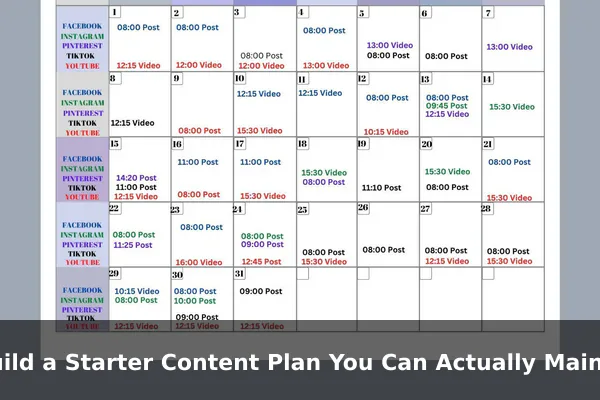
Consistency beats perfection in social media marketing. A beginner who posts three times a week for three months will outperform someone who posts daily for two weeks then disappears. Build a plan that fits your actual schedule, not an aspirational one you will abandon by week three.
Define Your Content Pillars
Content pillars are the three to four main topics your account covers. They keep your feed focused and make it easier to generate ideas. For example, a marketing consultant might use:
- Practical tips (how-to posts, quick wins)
- Behind the scenes (process, tools, workspace)
- Client results or social proof
- Personal perspective (opinions, lessons learned)
A Simple Weekly Posting Schedule
- Monday: Educational or how-to post
- Wednesday: Engagement post (question, poll, or relatable content)
- Friday: Promotional or story-based post
Three posts per week is a sustainable starting point. As your workflow improves, you can scale up without burning out.
Create Posts That Educate, Engage, and Convert
Every post should serve a purpose. Use a mix of post types so your feed does not feel monotonous and your audience stays interested across different stages of awareness.
Effective Post Types for Beginners
- How-to posts: Step-by-step instructions that solve a specific problem.
- Tips and lists: Easy-to-digest value that gets saved and shared.
- Behind-the-scenes: Humanizes your brand and builds trust.
- Question posts: Invites comments and boosts engagement signals.
- Social proof: Testimonials, results, or case studies that build credibility.
Writing Captions That Work
A strong caption starts with a hook — the first line that stops the scroll. Follow it with value-rich content, then end with a clear call to action (CTA) such as “Save this for later,” “Drop a comment below,” or “Click the link in bio.” Keep visuals consistent using a simple color palette and readable fonts. Free tools like Canva cover everything a beginner needs.
Use a Simple Workflow for Posting and Community Management
A repeatable workflow removes decision fatigue and keeps you from skipping posts when life gets busy. Build a lightweight system that covers content creation, scheduling, and engagement.
A Beginner’s Weekly Workflow
- Sunday (30 min): Plan and draft posts for the week using your content pillars.
- Monday morning: Design graphics in Canva, write captions, and schedule using Buffer or Meta Business Suite.
- Daily (10–15 min): Reply to comments and DMs. Engage with two to three accounts in your niche.
- End of week (15 min): Review basic metrics — reach, engagement, top posts — and note what to repeat.
Recommended beginner tools: Buffer or Later for scheduling, Canva for design, and each platform’s native analytics for performance tracking.
Common Beginner Mistakes to Avoid
Knowing what not to do saves you weeks of wasted effort. These are the most frequent missteps beginners make when starting social media marketing:
- Being on too many platforms: Focus beats spread every time.
- Inconsistent posting: Gaps of two or more weeks reset your momentum with the algorithm and your audience.
- Posting without a goal: If you do not know why you are posting, neither does your audience.
- Ignoring analytics: Even basic data shows you what is and is not working.
- Being too promotional: Follow the 80/20 rule — 80% value, 20% promotion.
- Copying trends blindly: Trends work when they align with your brand. Forcing them looks inauthentic.
A 30-Day Social Media Marketing Starter Plan
Use this first-month roadmap to move from zero to a steady posting routine with clear direction.
Week 1: Setup and Foundation
- Define your target audience (age, interests, problems, platform preference).
- Choose one or two platforms based on the audience match guide above.
- Optimize your profile: clear bio, profile photo, and link in bio.
- Set your one primary goal for the month.
Week 2: Content Creation
- Define three to four content pillars relevant to your niche.
- Create your first week of content (three to five posts).
- Set up a Canva brand kit with your colors and fonts.
- Schedule your first batch of posts using a free scheduling tool.
Week 3: Publish and Engage
- Post consistently according to your schedule.
- Reply to every comment and DM within 24 hours.
- Follow and engage with five to ten accounts in your niche each day.
Week 4: Review and Adjust
- Review your analytics: which posts got the most reach and engagement?
- Identify one content format that performed well and double down on it.
- Plan your content for month two based on what you learned.
Social media marketing is a long game, but the foundational moves you make in your first 30 days set the tone for everything that follows. Keep your approach simple, stay consistent, and let the data guide your improvements over time. The best time to start is now — with a single platform, one clear goal, and content that genuinely helps your audience.
