
Most businesses selling directly to everyday consumers already practice B2C marketing — they just don’t always call it that. B2C, or business-to-consumer marketing, is the set of strategies and tactics a brand uses to attract, engage, and convert individual buyers rather than other businesses. Whether you’re running an online store, a local service, or a consumer app, understanding how B2C marketing works gives you a clear framework for growth.
The difference between having a strategy and just running campaigns is significant. Without a strategy, you end up spending on channels that don’t match your audience, crafting messaging that doesn’t resonate, and running offers that attract the wrong buyers. This article breaks down what B2C marketing actually is, how to build a strategy behind it, which tactics deliver results, and what good execution looks like in practice.
What B2C Marketing Actually Means
B2C marketing is the process of promoting products or services directly to individual consumers. The goal is to move a person from awareness — simply knowing a brand exists — through interest, consideration, desire, and ultimately a buying decision. Unlike B2B marketing, which targets purchasing managers and involves long approval cycles, B2C marketing deals with faster decisions, stronger emotional triggers, and larger audiences reached at scale.
How B2C Differs from B2B Marketing
- Audience size: B2C brands target broad consumer segments; B2B brands focus on narrow business personas with specific job roles.
- Decision speed: Consumer purchases can happen in seconds; business purchases often involve committees and months of evaluation.
- Emotional vs. rational appeal: B2C messaging leans into emotion, identity, and aspiration; B2B messaging centers on ROI, efficiency, and risk reduction.
- Price sensitivity: Consumers respond strongly to deals, urgency, social proof, and perceived value.
Understanding this distinction shapes every part of how you write copy, choose channels, and structure your offers.
The Core Elements of a Strong B2C Marketing Strategy
Strategy always comes before tactics. A B2C marketing strategy defines who you’re targeting, what you’re saying, where you’re showing up, and why someone should choose you over a competitor. Without it, even well-executed campaigns lack direction and produce inconsistent results.
Know Your Audience
Effective B2C marketing starts with a clear picture of your buyer. This means going beyond basic demographics like age and location to understand motivations, frustrations, lifestyle habits, and buying triggers. Use surveys, product reviews, social listening, and purchase data to build a real, detailed profile of who buys from you and why.
Define Your Positioning and Value Proposition
Positioning answers the question: why you, not someone else? Your value proposition is the clearest possible statement of what you offer, who it’s for, and what makes it better than alternatives. Brands that skip this step end up sounding like every other option in their category — and consumers notice.
Map the Customer Journey
The B2C customer journey typically moves through five stages: awareness, consideration, decision, purchase, and retention. Different tactics apply at each stage. A first-time site visitor needs different messaging than someone who added a product to their cart three days ago and hasn’t returned.
How B2C Marketing Tactics Turn Strategy Into Results
Tactics are the specific actions you take within your strategy. They include the channels you use, the content you create, the offers you run, and the campaigns you launch. Here are the most effective B2C marketing tactics in use today:
- Content marketing: Blog posts, videos, and guides that attract and educate potential buyers through organic discovery.
- Email campaigns: Nurture sequences, abandoned cart emails, and promotional sends that consistently convert at high rates.
- Social media marketing: Brand presence and paid campaigns on platforms like Instagram, TikTok, and Facebook where consumers already spend time.
- Paid advertising: Google Shopping, Meta Ads, and display campaigns that drive immediate, targeted traffic.
- Influencer partnerships: Collaborations with creators who carry the trust of your target audience and can demonstrate your product authentically.
- Loyalty programs: Reward schemes that encourage repeat purchases and meaningfully increase customer lifetime value.
- Promotions and urgency: Limited-time offers, flash sales, and bundled deals that accelerate buying decisions without permanently discounting your brand.
Popular B2C Marketing Channels and When to Use Them
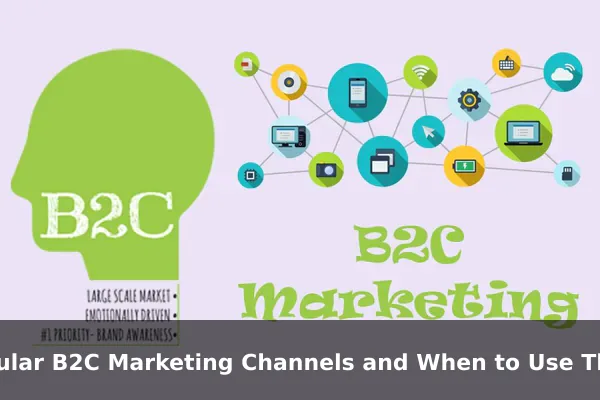
Not every channel fits every stage of the funnel. Choosing the right one depends on your goal — whether that’s building awareness, driving consideration, converting browsers, or retaining existing customers.
Awareness Channels
Use social media, display advertising, YouTube pre-roll, and influencer content to introduce your brand to new audiences. The goal at this stage is reach and recognition, not immediate sales. Measuring impressions, video views, and follower growth gives you a sense of whether awareness efforts are working.
Consideration and Conversion Channels
SEO and content marketing pull in people actively searching for what you offer. Retargeting ads and behavioral email sequences re-engage people who showed initial interest but didn’t convert. These channels are where intent meets opportunity — and where your positioning and value proposition do the heaviest lifting.
Retention Channels
Post-purchase email flows, loyalty apps, SMS marketing, and branded community spaces keep existing customers coming back. Retention is often cheaper and more profitable than acquisition — yet many B2C brands consistently underinvest here and focus almost entirely on new customer growth.
Examples of B2C Marketing in Action
Real examples make these concepts easier to apply. Consider how a mid-sized skincare brand might use B2C marketing as a connected system across the full funnel:
- Awareness: A beauty creator posts an honest review on Instagram Reels, reaching 200,000 followers who match the brand’s core demographic of women aged 25–40 with an interest in clean ingredients.
- Consideration: A viewer clicks through to the brand’s website, reads a blog post titled “how to choose the right moisturizer for dry skin,” and spends time on the product page comparing options.
- Conversion: An exit-intent popup offers 10% off the first order. The visitor subscribes to the email list and completes the purchase within the same session.
- Retention: A post-purchase email series educates the new customer on how to get the most from the product, followed by a loyalty points update and a referral incentive three weeks later.
This is B2C marketing working as an integrated system — each piece connects to the next and serves a defined role in the journey.
Common B2C Marketing Mistakes to Avoid
Even well-resourced brands make avoidable errors that limit growth or damage brand perception. These are the most common ones:
- Targeting everyone: Without a defined audience, messaging becomes generic and campaigns consistently underperform against specific competitors.
- Over-relying on discounts: Constant promotions train customers to wait for sales, erode your margin, and devalue the brand over time.
- Ignoring mobile: The majority of B2C purchases now happen on mobile devices. A slow or broken mobile experience kills conversions before they can happen.
- Inconsistent branding: Different tones, visuals, and messages across channels create confusion rather than building the recognition that drives long-term trust.
- Neglecting existing customers: Focusing entirely on acquisition while ignoring post-purchase retention is one of the most expensive structural mistakes in B2C marketing.
How to Measure B2C Marketing Performance
Marketing without measurement is just spending. These are the core KPIs that B2C brands should track consistently:
- Traffic and traffic sources: Where are visitors coming from, and which channels are bringing in the most qualified potential buyers?
- Conversion rate: The percentage of visitors who complete a purchase or other defined target action on your site.
- Customer acquisition cost (CAC): The total amount you spend to bring in one new paying customer across all channels.
- Return on ad spend (ROAS): Revenue generated for every dollar invested in paid advertising campaigns.
- Repeat purchase rate: How often existing customers return to buy again — a direct signal of retention health.
- Customer lifetime value (CLV): The total revenue a single customer generates across their entire relationship with your brand.
Track these numbers consistently, not just during active campaigns, to build a clear picture of what’s actually driving sustainable growth versus short-term spikes.
Building a Simple B2C Marketing Plan
Turning strategy into action doesn’t require a complex framework. This seven-step approach gives any consumer brand a working foundation:
- Define your target audience — write a specific, detailed profile of the person you’re trying to reach, including their motivations and where they spend time online.
- Set a clear goal — decide whether your current focus is acquisition, retention, revenue per customer, or a combination.
- Choose two or three channels — don’t spread resources thin across every platform; build mastery on a few before expanding.
- Craft your core message — define what you want your audience to feel, believe, or do as a result of seeing your marketing.
- Plan content and offers — map out what you’ll publish, send, or promote over the next 30 to 90 days with specific dates and owners.
- Set KPIs before you launch — agree on what success looks like before spending any budget, so evaluation stays objective.
- Review and adjust monthly — use your performance data to double down on what’s working and cut what isn’t showing results.
B2C marketing is not a one-time campaign — it’s an ongoing system that compounds over time as you learn more about your customers and sharpen how you reach them. Start with a clear strategy, execute through the right mix of tactics, measure what matters, and keep building on what works.
