
Lead generation is one of the most important activities any business can do. Whether you run a software company, a local service business, or an e-commerce store, growth depends on a steady flow of potential customers showing interest in what you offer. Without leads, there is no pipeline. Without a pipeline, there is no revenue.
This article explains what lead generation is, how the process works, and which strategies businesses use to attract and convert new prospects. You will also find real examples, common mistakes to avoid, and a simple framework to help you launch or improve your results.

What Lead Generation Means in Marketing
A lead is a person or company that has shown some interest in your product or service. Lead generation is the process of attracting those people and collecting their contact information so your sales or marketing team can follow up.
Not everyone who visits your website is a lead. A lead is someone who has taken a deliberate action that signals intent — filling out a form, downloading a guide, signing up for a free trial, or requesting a quote. That action separates a passive visitor from an active prospect.
Where Leads Fit in the Customer Journey
Lead generation sits near the top of the marketing funnel. It bridges the gap between brand awareness and the sales process. Once a lead is captured, the goal is to move them through the funnel by building trust, providing value, and nurturing interest until they are ready to buy.
- Awareness: A potential customer discovers your business through a blog post, ad, or social post.
- Engagement: They interact with your content or landing page.
- Lead capture: They provide their contact details in exchange for something valuable.
- Nurture: You follow up with relevant information and offers over time.
- Conversion: They become a paying customer.
Why Lead Generation Matters for Business Growth
Consistent lead generation creates a predictable pipeline. Instead of relying on word-of-mouth or random traffic spikes, businesses with a lead generation system know where new customers will come from and roughly how many to expect each month.
Lead generation also gives you control over who you target. You can focus your efforts on the types of customers most likely to buy, stay loyal, and spend more over time. This makes your marketing budget more efficient and your sales team more productive.
Revenue Impact and Scalability
When your funnel has a steady input of qualified prospects, revenue becomes more stable and scalable. You can plan hiring, inventory, and service capacity with confidence because you have data on how many leads convert and at what rate. Businesses that invest in structured lead generation consistently outgrow those that rely on passive or unpredictable channels.
How the Lead Generation Process Works
The lead generation process follows a logical flow. Understanding each step helps you identify where your current approach may be losing potential customers.
Step 1: Attract
Draw the right audience to your website, profile, or content through organic search, paid advertising, social media, referrals, or events. The goal is to reach people who already have a problem your product or service can solve.
Step 2: Engage
Once they arrive, your content or page needs to hold their attention long enough for them to take the next step. A helpful blog post, a compelling product description, or a clear landing page keeps visitors interested.
Step 3: Capture
This is the moment you collect contact information, usually through a form. The key is offering something valuable in return — a free guide, a discount, a webinar, or a free consultation. Without a strong offer, most visitors leave without converting.
Step 4: Qualify and Nurture
Not every lead is ready to buy immediately or is the right fit. Qualification helps you sort leads by their likelihood to convert. Nurturing involves sending relevant content and offers over time to build trust and keep your business top of mind until the lead is ready to make a decision.
Core Lead Generation Strategies Businesses Use
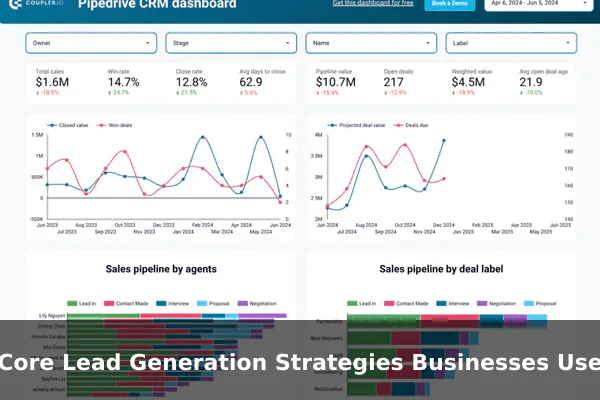
There is no single approach that works for every business. Most successful programs combine several channels and tactics based on audience, budget, and goals.
Content Marketing and SEO
Creating useful blog posts, guides, or tools that attract your target audience organically is one of the most cost-effective long-term strategies. A business selling accounting software, for example, might publish content targeting searches like “how to manage business expenses” to attract small business owners already looking for help. SEO ensures that content ranks when people search for those solutions.
Paid Advertising
Paid ads on Google, Meta, or LinkedIn allow you to target specific audiences and drive traffic quickly. Paid lead generation works best when paired with a focused landing page and a strong offer rather than sending traffic to a general homepage.
Email and Landing Pages
Email is one of the highest-ROI channels for capturing and nurturing leads. A well-placed sign-up form combined with a welcome sequence can move new subscribers from curious to ready-to-buy faster than almost any other channel. A landing page is a dedicated page built to convert visitors into leads. Common lead magnets include:
- Free eBooks, guides, or checklists
- Templates or tools
- Free trials or product demos
- Webinars or mini-courses
- Discount codes or exclusive early access
Referrals and Partnerships
Satisfied customers and business partners can send highly qualified leads your way. Referral programs formalize this by incentivizing recommendations. Because referred leads come with built-in trust, they tend to convert at higher rates and cost less to acquire.
Lead Generation Examples Across Different Business Types
Lead generation looks different depending on the business model. These examples show how it works in practice across several common scenarios.
B2B SaaS Company
A software company offers a 14-day free trial. Visitors sign up with their business email, which triggers an automated email sequence showing use cases, a customer case study, and an invitation to a live product demo. The trial is the lead magnet, the email sequence is the nurture, and the demo is where the sales team takes over.
Local Service Business
A plumbing company runs Google search ads targeting “emergency plumber near me.” Clicks land on a page with one clear call to action: “Get a Free Quote in Minutes.” The form captures name, phone number, and service type. A sales rep calls within the hour.
E-Commerce Store
An online retailer uses a pop-up offering 15% off a first order in exchange for an email address. A follow-up email sequence reminds the subscriber of the discount, introduces new arrivals, and drives the first purchase.
Consultant or Agency
A marketing consultant publishes long-form content targeting business owners searching for strategic help. Each post ends with a downloadable PDF version available in exchange for an email. Leads who download are nurtured via a weekly newsletter that builds credibility over several weeks before a sales conversation is invited.
What Makes a Lead Generation Campaign Effective
Many businesses generate lead volume but produce poor results. The difference between high-quality and low-quality lead generation comes down to a few factors:
- Audience fit: Your offer and messaging must match the specific problem your target customer has right now.
- Clear value exchange: The lead magnet must be valuable enough to justify sharing contact details.
- Simple forms: Asking for too much information upfront reduces conversions. Start with name and email.
- Fast follow-up: Responding to a new lead within minutes dramatically increases conversion rates.
- Focused landing pages: A dedicated page with one goal converts far better than a homepage.
Common Lead Generation Mistakes to Avoid
Targeting Too Broadly
Trying to attract everyone means your message resonates with no one. Effective lead generation starts with a specific audience and a specific problem. The narrower your targeting, the better your lead quality.
No Follow-Up System
Capturing a lead and failing to follow up is one of the most costly mistakes in marketing. An automated email sequence ensures no lead falls through the cracks between your form and your sales team.
Focusing on Volume Over Quality
A list of 200 highly qualified leads will outperform a list of 2,000 unqualified ones every time. Optimize for lead quality by improving your targeting, lead magnet relevance, and the questions your form asks.
How to Measure Lead Generation Results
Measurement tells you what is working, what to cut, and where to invest more. Key metrics every business should track include:
- Conversion rate: The percentage of visitors who become leads — typically 2% to 10% for landing pages depending on the offer and source.
- Cost per lead (CPL): How much it costs to acquire one lead across each channel.
- Lead quality score: How likely a given lead is to convert based on their profile and behavior.
- Source performance: Which channels drive the most leads and the most eventual customers.
- Lead-to-customer rate: The percentage of leads that eventually become paying customers — the ultimate measure of lead generation effectiveness.
Simple Lead Generation Framework for Getting Started
If you are just starting out or want to improve current results, this step-by-step framework gives you a clear path forward.
- Define your ideal customer. Describe who you are trying to reach, what problem they have, and what they care about most.
- Choose one or two channels. Start where your audience already spends time before expanding to additional platforms.
- Create a compelling offer. Build a lead magnet that delivers real, immediate value to your target customer.
- Build a simple landing page. One headline, one benefit statement, one short form, and one clear call to action.
- Set up a follow-up sequence. Write three to five emails that deliver value, build trust, and invite the next step.
- Drive traffic. Use one paid channel or one organic strategy to bring visitors to your landing page consistently.
- Track and improve. Review your conversion rate, cost per lead, and lead-to-customer rate monthly and adjust what is not working.
Lead generation is not a one-time task. It is an ongoing system that improves with consistent attention, testing, and refinement. Businesses that treat it as a core function — not an afterthought — build pipelines that support steady, predictable growth.
Start simple, measure from day one, and add complexity only when the fundamentals are working. A reliable lead generation system that runs consistently is far more valuable than a sophisticated one that never gets off the ground.
